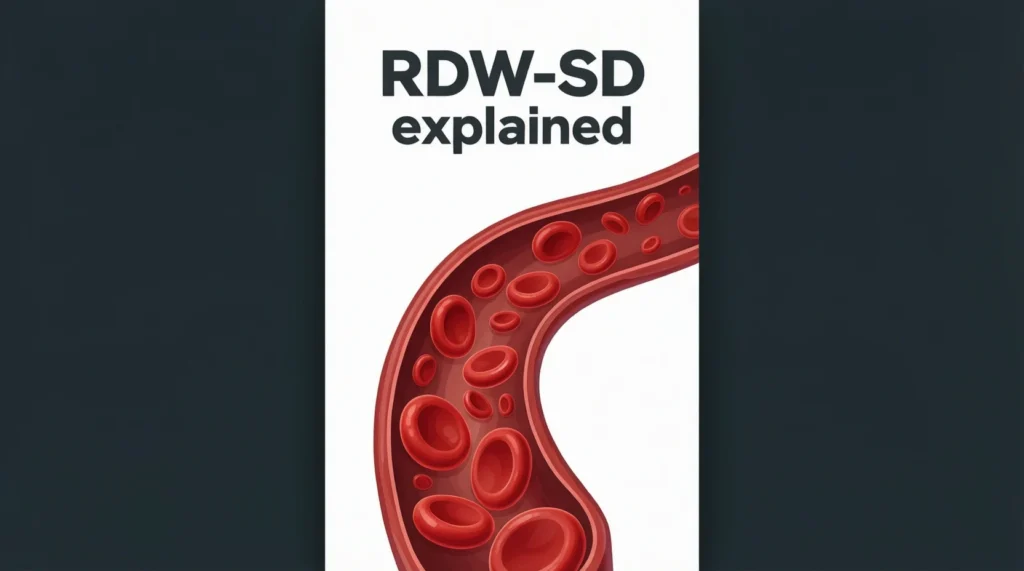
RDW-SD (Red Cell Distribution Width–Standard Deviation) is a measurement in a complete blood count (CBC) that shows how much variation exists in the size of your red blood cells, reported in femtoliters (fL).
A higher RDW-SD means there is greater variability in red blood cell size (anisocytosis), while a lower or normal RDW-SD indicates more uniform cell size.
Why This Number Matters
You open your lab results and see a string of abbreviations WBC, HGB, MCV… and then RDW-SD. It’s easy to overlook, but this small number can offer meaningful insight into your blood health, nutrient status, and even certain chronic conditions. Understanding what RDW-SD means helps you interpret your CBC more confidently and have clearer conversations with your healthcare provider.
This guide breaks down RDW-SD in simple language what it measures, why doctors check it, how to interpret high or low values, and how it compares to similar blood test markers.
What RDW-SD Measures in Simple Terms
Red blood cells (RBCs) carry oxygen throughout your body. Ideally, they are similar in size. But when there’s a mix of very small and very large cells, it may signal nutritional deficiencies, bone marrow changes, or chronic disease.
RDW-SD measures the spread (variation) of red blood cell sizes not the average size, but the range of differences.
Key points:
- Unit of measurement: femtoliters (fL)
- Found in: Complete Blood Count (CBC)
- Reflects: Size variability of red blood cells
- Medical term for variability: Anisocytosis
Normal RDW-SD Range
Ranges vary slightly by laboratory, but most reference intervals fall within:
| Category | RDW-SD Value |
|---|---|
| Low | Below ~37 fL |
| Normal | ~37–54 fL |
| High | Above ~54 fL |
Always interpret results using the reference range printed on your lab report.
Origin of RDW-SD: How It Became a Standard Lab Marker
RDW measurements were introduced as automated blood analyzers became more sophisticated in the late 20th century. Earlier, doctors evaluated red blood cell variation by examining a smear under a microscope—accurate but time-consuming.
Modern analyzers now:
- Measure thousands of red blood cells
- Calculate size distribution instantly
- Provide precise statistical measurements
Two RDW metrics emerged:
- RDW-CV (coefficient of variation, percentage-based)
- RDW-SD (standard deviation, absolute measurement)
RDW-SD gained popularity because it does not depend on the average cell size, making it more stable in certain clinical situations.
Why Doctors Order RDW-SD
RDW-SD isn’t typically interpreted alone. It works alongside other RBC indices such as:
- MCV (Mean Corpuscular Volume) average RBC size
- Hemoglobin (HGB) oxygen-carrying protein
- Hematocrit (HCT) proportion of RBCs in blood
Together, these values help diagnose types of anemia and evaluate overall blood health.
Common clinical uses:
- Evaluating iron deficiency
- Identifying vitamin B12 or folate deficiency
- Assessing chronic disease anemia
- Monitoring bone marrow disorders
- Supporting cardiovascular risk evaluation in some research contexts
High RDW-SD: What It Can Indicate
A high RDW-SD means red blood cells vary widely in size. This is one of the earliest laboratory signs of certain deficiencies.
Possible causes of elevated RDW-SD:
Nutritional deficiencies
- Iron deficiency anemia
- Vitamin B12 deficiency
- Folate deficiency
Blood-related conditions
- Hemolytic anemia
- Sickle cell disease
- Thalassemia (in some cases)
- Recent blood transfusion
Chronic illness
- Liver disease
- Kidney disease
- Inflammatory conditions
Bone marrow disorders
- Myelodysplastic syndromes
- Marrow recovery after treatment
What symptoms might accompany high RDW-SD?
Not from RDW-SD itself but from underlying causes:
- Fatigue
- Pale skin
- Shortness of breath
- Weakness
- Dizziness
Low RDW-SD: Is It a Concern?
Low RDW-SD means red blood cells are very uniform in size. This is usually not clinically significant on its own.
Doctors rarely diagnose conditions based solely on a low RDW-SD. It may appear in:
- Some chronic disease patterns
- Normal healthy individuals
Think of low RDW-SD as a “consistency indicator” rather than a warning sign.
RDW-SD vs RDW-CV: What’s the Difference?
Both measure red blood cell size variability but in different ways.
| Feature | RDW-SD | RDW-CV |
|---|---|---|
| Measurement type | Absolute width of size distribution | Percentage variation |
| Unit | Femtoliters (fL) | Percent (%) |
| Influenced by average RBC size | No | Yes |
| Stability across conditions | More stable | Can fluctuate with MCV |
| Clinical usefulness | Clear representation of size spread | Commonly reported with CBC |
In simple terms:
RDW-SD shows the actual spread of cell sizes, while RDW-CV shows variability relative to the average size.
RDW-SD and MCV: A Powerful Diagnostic Pair
Doctors often interpret RDW-SD together with MCV to classify anemia types.
Example interpretation table
| RDW-SDMCVPossible Meaning | ||
|---|---|---|
| High | Low | Iron deficiency anemia |
| High | Normal | Early nutritional deficiency |
| High | High | Vitamin B12 or folate deficiency |
| Normal | Low | Thalassemia trait |
| Normal | Normal | Likely no anemia |
This pairing helps pinpoint the underlying cause more accurately than either value alone.
Real-World Usage: How RDW-SD Appears in Lab Reports
When you receive a CBC, RDW-SD typically appears under RBC indices.
Example lab format:
| Test | Result | Reference Range |
|---|---|---|
| Hemoglobin | 12.8 g/dL | 12.0–15.5 |
| MCV | 78 fL | 80–100 |
| RDW-SD | 58 fL | 37–54 |
Interpretation: High RDW-SD + low MCV often suggests iron deficiency.
Tone-Based Example Interpretations
Understanding medical results can feel different depending on context. Here are communication styles healthcare professionals might use.
Friendly explanation 🙂
“Your RDW-SD is a little elevated, which can happen when red blood cells vary in size. It often relates to iron levels, so we’ll check that next.”
Neutral clinical explanation
“Elevated RDW-SD indicates increased red cell size variability. Correlation with MCV suggests possible microcytic anemia.”
Reassuring professional tone
“This value alone doesn’t confirm a diagnosis. We interpret it alongside your other CBC markers.”
Conditions Commonly Associated With RDW-SD Changes
Iron Deficiency Anemia
- Often shows high RDW-SD
- Cells become smaller over time
- Common in pregnancy, heavy periods, low dietary iron
Vitamin B12 or Folate Deficiency
- Large red blood cells increase variability
- Neurological symptoms may occur
Chronic Disease Anemia
- May show normal or slightly elevated RDW-SD
- Seen in kidney disease, autoimmune conditions
Bone Marrow Disorders
- Irregular RBC production
- Wide variation in cell sizes
Alternate Meanings of RDW-SD
Outside laboratory medicine, RDW-SD has minimal alternative meanings. Occasionally, abbreviations may differ by context, but in healthcare it almost always refers to Red Cell Distribution Width–Standard Deviation.
Professional or Layperson-Friendly Ways to Refer to RDW-SD
If explaining results without jargon, you might say:
- “Variation in red blood cell size”
- “Spread of red blood cell sizes”
- “Consistency of red blood cells”
- “Red blood cell size range”
These alternatives help patients understand the concept without technical language.
Practical Tips for Interpreting RDW-SD
✔ Never interpret RDW-SD alone
✔ Review MCV and hemoglobin together
✔ Compare with previous lab results
✔ Ask about nutritional status
✔ Follow your provider’s guidance before making changes
FAQs
1. What does a high RDW-SD mean in a blood test?
A high RDW-SD indicates greater variation in red blood cell size, often linked to iron deficiency, vitamin B12 deficiency, or other blood disorders.
2. Is RDW-SD more accurate than RDW-CV?
RDW-SD is considered more stable because it is not influenced by average cell size (MCV), but both values are useful together.
3. Can RDW-SD detect anemia early?
Yes. RDW-SD can increase before other markers change, making it an early indicator of some types of anemia.
4. What is a normal RDW-SD level?
Most labs consider approximately 37–54 femtoliters as normal, though ranges vary.
5. Should I worry about low RDW-SD?
Low RDW-SD is usually not clinically significant and rarely indicates disease.
6. Can diet affect RDW-SD?
Yes. Iron, vitamin B12, and folate deficiencies can increase RDW-SD.
7. How is RDW-SD measured?
Automated blood analyzers measure red blood cell size distribution during a CBC test.
8. What tests are reviewed with RDW-SD?
Doctors commonly evaluate RDW-SD alongside MCV, hemoglobin, hematocrit, and RBC count.
Conclusion
Understanding RDW-SD can feel intimidating at first, but it’s actually a very informative part of your complete blood count. This single number reveals how uniform or varied your red blood cells are, which can help detect early signs of anemia, nutrient deficiencies, or other blood-related conditions.
By paying attention to RDW-SD along with other CBC markers, you gain a deeper understanding of your blood health, making you better equipped to discuss results, identify potential issues early, and maintain overall wellness. 💡
Discover More Related Articles:

Sarah Williams is the passionate author behind WordNexy.com, dedicated to creating content that informs, inspires, and sparks curiosity. With a love for words and storytelling, she transforms ideas into meaningful articles that educate, entertain, and leave a lasting impression on every reader.