Reconciliation in the Bible means the restoration of a broken relationship, especially between God and humanity, made possible through Jesus Christ.
It involves removing hostility caused by sin and replacing it with peace, forgiveness, and renewed fellowship through God’s grace.
What does reconciliation mean in the Bible, and why is it such a central message of Christianity? From Genesis to Revelation, the Bible tells a story of broken relationships and God’s loving plan to restore them. Reconciliation is not a side theme. It is the heart of the gospel itself.
In everyday life, reconciliation may mean making peace after an argument or restoring trust after conflict. In the Bible, reconciliation goes deeper. It describes how God restores a broken relationship between Himself and humanity, a separation caused by sin, through the saving work of Jesus Christ.
This article explains the biblical meaning of reconciliation in a clear, friendly, and practical way, covering its origin, usage, examples, related terms, and real life application.
Understanding Reconciliation in the Biblical Context
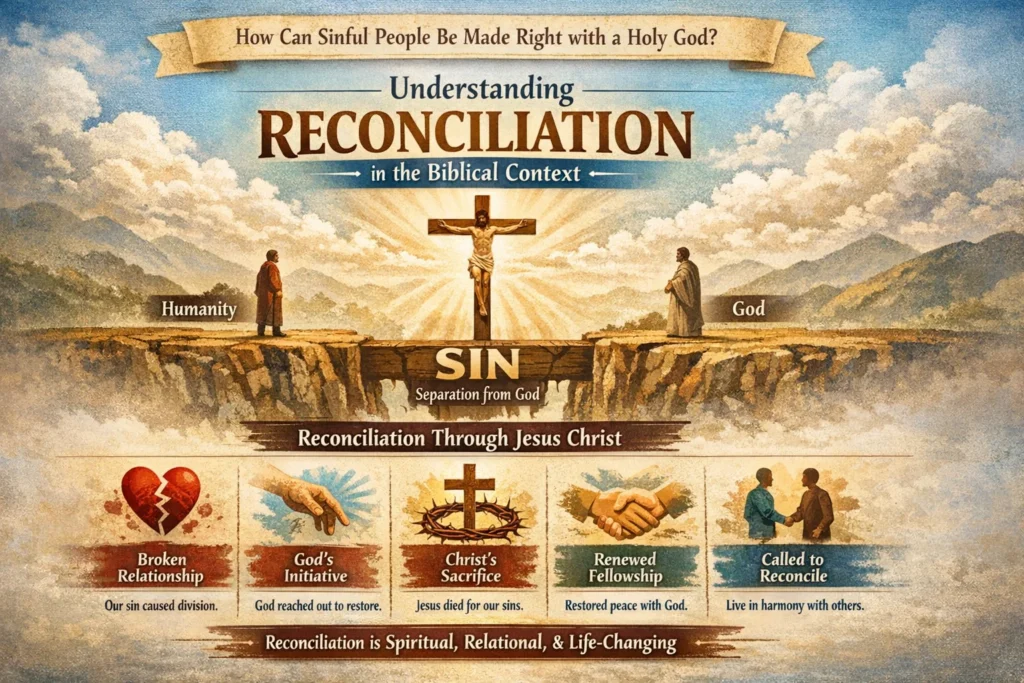
Reconciliation answers a crucial spiritual question: How can sinful people be made right with a holy God?
The Bible teaches that sin created separation between God and humanity. Reconciliation is God’s solution to that separation, not by ignoring sin, but by fully dealing with it through Jesus Christ.
Key elements of biblical reconciliation include:
• A broken relationship caused by sin
• God’s initiative in restoring peace
• Christ’s sacrifice as the means of restoration
• Renewed fellowship between God and people
• A calling for believers to live reconciled lives with others
Reconciliation is not just emotional. It is spiritual, relational, and life changing.
Origin of Reconciliation in the Bible
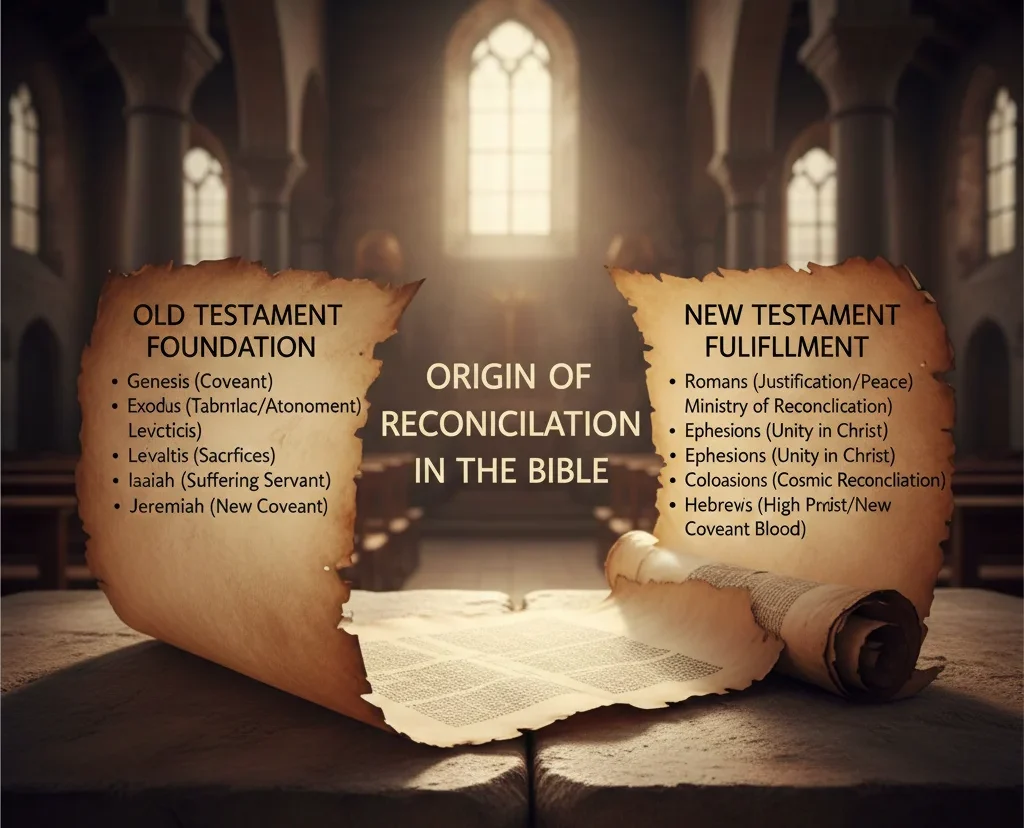
Old Testament Foundation
Although the word reconciliation appears more often in the New Testament, the concept begins in the Old Testament.
In the Hebrew Scriptures, reconciliation is closely tied to:
• Atonement
• Sacrificial offerings
• Covenant restoration
The Day of Atonement described in Leviticus shows how sin required cleansing and how God provided a way for relationship to be restored. These sacrifices pointed forward to something greater.
New Testament Fulfillment
The New Testament reveals reconciliation fully through Jesus Christ.
Key passages include:
• Romans 5:10 shows that while humanity was still God’s enemy, reconciliation was made through Christ
• 2 Corinthians 5:18 to 19 explains that God reconciled us to Himself and gave believers the ministry of reconciliation
• Colossians 1:20 teaches that peace was made through Christ’s blood on the cross
In the New Testament, reconciliation is no longer temporary or repeated. It is complete and permanent through Jesus.
Popularity and Usage of Reconciliation in Christianity
In Theology and Teaching
Reconciliation is central to Christian doctrine because it explains:
• Why Jesus came
• What the cross accomplished
• How salvation restores relationship, not just moral standing
It is commonly taught in sermons, Bible studies, and theological discussions about grace, forgiveness, and unity.
In Daily Christian Life
Christians encounter reconciliation in everyday situations such as:
• Forgiving someone who caused pain
• Restoring peace after conflict
• Healing divisions in families and churches
Biblical reconciliation provides depth and direction by focusing on God’s example rather than human effort alone.
Biblical Meaning of Reconciliation Explained Simply
Reconciliation in the Bible operates on three levels.
Reconciliation Between God and Humanity
This is the most important meaning.
Human sin caused separation from God. God lovingly took the first step to restore that relationship. Through Jesus’ death and resurrection, the barrier of sin was removed, and believers are brought back into fellowship with God.
This is vertical reconciliation.
Reconciliation Between People
Once reconciled to God, believers are called to reconcile with others.
Jesus taught forgiveness, humility, and peace. Christians are encouraged to pursue restored relationships whenever possible.
This is horizontal reconciliation.
Reconciliation of All Creation
The Bible also points to a future restoration where all brokenness will be healed. God’s plan includes renewing the entire world and establishing lasting peace.
Examples of Reconciliation in the Bible
Biblical Examples Table
| Example | Context | Meaning |
|---|---|---|
| God and humanity | Romans 5 | Enemies restored through Christ |
| Joseph and his brothers | Genesis 45 | Forgiveness after betrayal |
| The prodigal son | Luke 15 | Restoration after rebellion |
| Jews and Gentiles | Ephesians 2 | Unity across division |
Tone Based Usage Examples
Friendly tone
God did not wait for us to fix ourselves. He reconciled us to Himself through Jesus.
Neutral tone
Reconciliation in the Bible refers to restored relationship after separation caused by sin.
Corrective or serious tone
Without reconciliation, unresolved sin leads to spiritual and relational distance.
Reconciliation Compared With Related Biblical Terms
| Term | Meaning | Difference |
|---|---|---|
| Reconciliation | Restored relationship | Focuses on peace and unity |
| Salvation | Rescue from sin | Broader concept |
| Atonement | Removal of sin | Leads to reconciliation |
| Justification | Declared righteous | Legal standing |
| Forgiveness | Release of guilt | Part of reconciliation |
Reconciliation focuses on relationship rather than legal status alone.
Alternate Meanings of Reconciliation
Outside the Bible, reconciliation may refer to:
• Resolving conflicts
• Settling financial records
• Restoring social or political relationships
While similar in idea, biblical reconciliation is deeper because it involves spiritual restoration through God’s grace.
Professional or Polite Alternatives
Depending on context, similar expressions include:
• Restoration
• Renewal of relationship
• Peace making
• Healing division
However, reconciliation remains the most accurate biblical term.
Real World Application of Biblical Reconciliation
Biblical reconciliation shapes daily Christian living.
Practical applications include:
• Seeking forgiveness quickly
• Extending grace even when it is difficult
• Choosing humility over pride
• Promoting peace in relationships
Those reconciled to God are called to become ambassadors of reconciliation in the world.
FAQs
What is reconciliation in simple biblical terms?
It is the restoration of a broken relationship between God and humanity through Jesus Christ.
Why is reconciliation important in Christianity?
It explains how sinners can have peace with God and restored fellowship.
Is reconciliation the same as forgiveness?
No. Forgiveness is part of reconciliation, but reconciliation includes restored relationship.
Who initiates reconciliation according to the Bible?
God initiates reconciliation by sending Jesus Christ.
What Bible verse best explains reconciliation?
2 Corinthians 5:18 to 19 is one of the clearest explanations.
Do Christians need to reconcile with others?
Yes. Believers are called to pursue peace whenever possible.
Can reconciliation fail?
Human reconciliation may face resistance, but reconciliation with God through Christ is secure.
How does reconciliation affect daily life?
It encourages forgiveness, humility, and peace in relationships.
Conclusion
Reconciliation in the Bible is the heart of the gospel. It reveals a loving God who restores what sin has broken.
Through Jesus Christ:
• Separation becomes fellowship
• Guilt becomes forgiveness
• Conflict becomes peace
Reconciliation is both a gift to receive and a calling to live out. When understood biblically, it transforms relationships with God and with others.
Search More Related Articles:

Sarah Williams is the passionate author behind WordNexy.com, dedicated to creating content that informs, inspires, and sparks curiosity. With a love for words and storytelling, she transforms ideas into meaningful articles that educate, entertain, and leave a lasting impression on every reader.