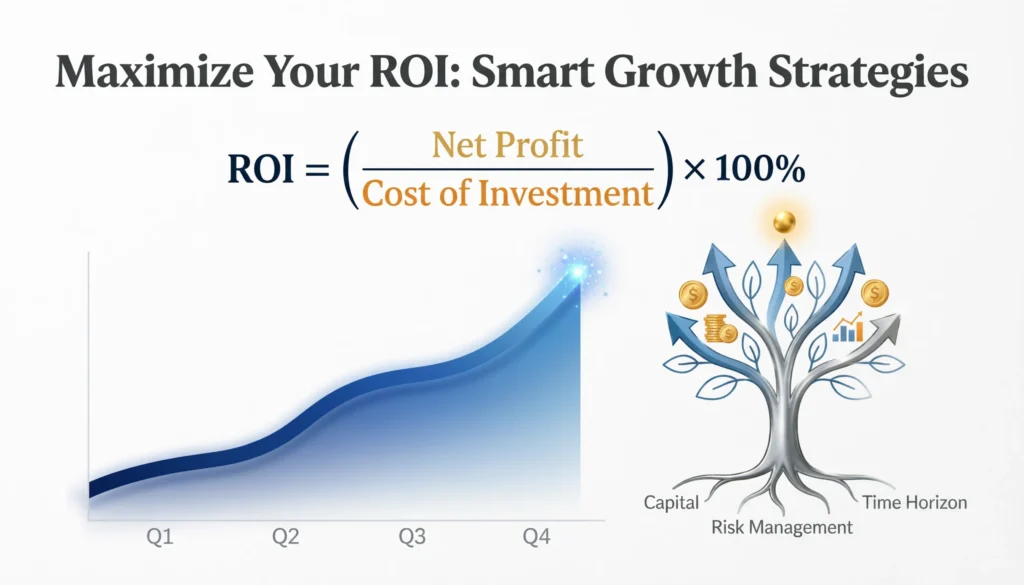
Definition:
ROI in business stands for Return on Investment. It is a financial metric used to measure the profitability of an investment by comparing the gain or loss generated to the amount of money invested.
If you’ve ever wondered whether a business decision actually paid off, you were really asking about ROI. From marketing campaigns to new equipment purchases, companies use Return on Investment to answer one simple question: Was it worth it?
ROI is one of the most widely used business metrics because it quickly shows how efficiently money is being used. Whether you run a company, manage a project, or simply want to understand business performance, knowing how ROI works gives you a clear view of financial success.
This guide explains ROI in plain language, including how it’s calculated, where it’s used, examples, comparisons, and practical tips.
What Is ROI in Business?
Return on Investment (ROI) measures how much profit or benefit an investment generates relative to its cost.
Basic Formula
ROI = (Net Profit ÷ Investment Cost) × 100
Simple Explanation
ROI tells you how much you gained compared to what you spent.
Quick Example
A company spends $1,000 on advertising and earns $1,500 in revenue from it.
Profit = $500
ROI = 50%
That means the business earned 50% of the original investment as profit.
Origin and Business Background
The concept of measuring returns on investments dates back to early commerce, when merchants tracked gains from trade ventures. As modern accounting developed, ROI became a standard tool for evaluating business performance.
Today, ROI is widely used in:
• Corporate finance
• Marketing analytics
• Investment analysis
• Project management
• Entrepreneurship
• Real estate evaluation
Its popularity comes from its simplicity and versatility. It works for both small decisions and large strategic investments.
Why ROI Matters in Business
Businesses constantly decide where to spend money. ROI helps determine whether those decisions produce value.
Key Benefits
• Measures profitability clearly
• Helps compare different investments
• Supports data-driven decision-making
• Identifies efficient use of resources
• Justifies spending to stakeholders
In short, ROI answers: “What did we get back for what we spent?”
Real-World Business Usage
ROI appears in many everyday business scenarios.
Marketing Campaigns
A company tracks sales generated from advertising spending.
Equipment Purchases
A manufacturer evaluates whether new machinery improves productivity enough to justify its cost.
Employee Training
Organizations measure performance improvements after training programs.
Technology Investments
Businesses assess whether new software increases efficiency or revenue.
ROI Calculation Explained Step-by-Step
Step 1: Determine Investment Cost
Include all expenses related to the investment.
Examples:
• Purchase price
• Setup costs
• Marketing expenses
• Maintenance fees
Step 2: Calculate Net Profit
Net Profit = Total Gain − Total Cost
Step 3: Apply the Formula
Divide net profit by the investment cost and multiply by 100.
ROI Example Table
| Investment Type | Cost | Profit Earned | ROI |
|---|---|---|---|
| Digital advertising | $2,000 | $1,000 | 50% |
| New equipment | $10,000 | $3,000 | 30% |
| Training program | $5,000 | $2,500 | 50% |
| Website redesign | $3,000 | $6,000 | 100% |
This table shows how ROI helps compare different business decisions quickly.
Types of ROI in Business Contexts
Although the formula is simple, businesses apply ROI in different ways.
Marketing ROI
Measures revenue generated from marketing campaigns.
Social Media ROI
Evaluates engagement, leads, or sales from social platforms.
Project ROI
Assesses profitability of a business project.
Investment ROI
Measures financial return from stocks, real estate, or ventures.
Human Capital ROI
Evaluates productivity gained from employee-related investments.
ROI vs Related Business Metrics
ROI is often compared with other financial indicators. Understanding the differences prevents confusion.
Comparison Table: ROI and Similar Metrics
| Metric | What It Measures | Focus |
|---|---|---|
| ROI | Profit relative to investment | Overall efficiency |
| ROA (Return on Assets) | Profit generated from assets | Asset performance |
| ROE (Return on Equity) | Profit relative to shareholder equity | Investor return |
| Profit Margin | Profit per revenue dollar | Operational profitability |
| Payback Period | Time to recover investment | Risk and timing |
Key Difference
ROI measures efficiency of spending, while other metrics focus on assets, ownership, or time recovery.
Tone and Context of ROI Usage
The meaning of ROI remains consistent, but tone changes based on context.
Professional Business Tone
“The project delivered a 25% ROI.”
Analytical Tone
“We compared ROI across departments.”
Positive Outcome
“Our marketing campaign achieved strong ROI.”
Negative Outcome
“The investment produced low ROI.”
ROI itself is neutral. Interpretation depends on results.
Practical Tips for Using ROI Correctly
Understanding ROI is helpful, but using it properly is what makes it powerful.
Best Practices
• Include all relevant costs
• Compare ROI across similar investments
• Use consistent timeframes
• Combine ROI with other metrics
• Consider non-financial benefits when relevant
Common Mistakes
• Ignoring hidden costs
• Using revenue instead of profit
• Comparing unrelated investments
• Focusing only on short-term results
Alternate Meanings of ROI
Outside business and finance, ROI can have other meanings, though they are context-specific.
Common Non-Business Meanings
• Region of Interest (in imaging or data analysis)
• Return on Influence (marketing analytics concept)
However, in business discussions, ROI almost always refers to Return on Investment.
Professional or Plain Language Alternatives
Depending on context, ROI may be expressed in simpler terms.
Business Alternatives
• Investment return
• Profitability ratio
• Investment efficiency
Plain Language Explanation
• How much you earned from what you spent
• Financial return compared to cost
These alternatives help explain ROI to non-technical audiences.
Example Scenario Walkthrough
Situation
A company spends $5,000 on a marketing campaign and generates $8,000 in new sales.
Calculation
Profit = $3,000
ROI = 60%
Interpretation
The business earned 60% of its investment as profit, indicating a successful campaign.
FAQs
1. What does ROI mean in business?
ROI stands for Return on Investment. It measures how profitable an investment is compared to its cost.
2. How do you calculate ROI?
Divide net profit by the investment cost and multiply by 100.
3. Is a higher ROI always better?
Generally yes, but risk, timeframe, and business goals also matter.
4. What is a good ROI in business?
It depends on industry and risk level, but positive ROI indicates profit.
5. Can ROI be negative?
Yes. Negative ROI means the investment lost money.
6. Why is ROI important for companies?
It helps evaluate spending decisions and measure financial success.
7. Is ROI used only for money?
Primarily yes, but some organizations measure ROI in efficiency or performance gains.
8. What is the difference between ROI and profit?
Profit shows earnings, while ROI shows efficiency of investment.
Conclusion
ROI, or Return on Investment, is one of the most important tools in business decision-making. It measures how effectively money is used by comparing profit to the original investment. Whether evaluating marketing campaigns, equipment purchases, or strategic initiatives, ROI provides a clear picture of value and performance.
Understanding ROI helps businesses allocate resources wisely, compare opportunities, and make data-driven decisions. By calculating ROI correctly and interpreting it alongside other financial indicators, organizations can identify what truly works and improve long-term profitability.
In simple terms, ROI answers a question every business must ask: Was the investment worth it?
Discover More Related Articles:
- PFP Mean in Text: Complete Guide for Social Media Users (2026)
- Shabbat Shalom Mean in English: Usage, and Significance in 2026

Sarah Williams is the passionate author behind WordNexy.com, dedicated to creating content that informs, inspires, and sparks curiosity. With a love for words and storytelling, she transforms ideas into meaningful articles that educate, entertain, and leave a lasting impression on every reader.