Definition
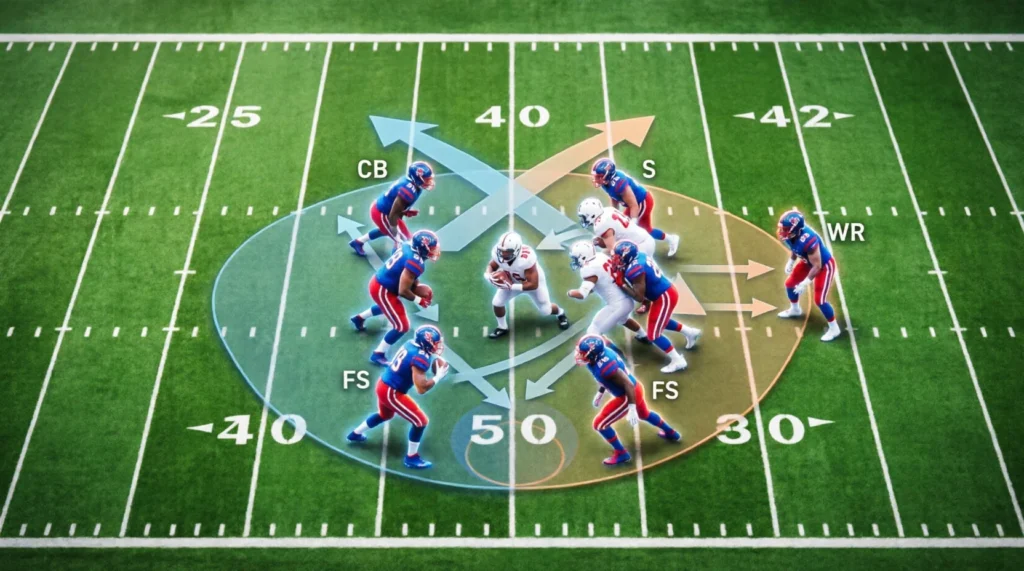
In football, the “secondary” refers to the group of defensive players positioned furthest from the line of scrimmage typically the cornerbacks and safeties whose primary job is to defend against passing plays and prevent big gains.
Ever watched a football game where a receiver runs deep, the ball flies through the air… and suddenly a defender appears out of nowhere to break up the play? 👀
That game-changing moment usually belongs to the secondary.
While offensive stars often grab headlines, the secondary quietly determines whether a team dominates—or gets exposed. In modern football, where passing offenses are stronger than ever, understanding what the secondary means in football is essential for fans, players, and analysts alike.
In this guide, we’ll break down everything you need to know—from roles and formations to real-world examples, tone usage, and comparisons.
🏈 Understanding the Secondary

The secondary is often called the defensive backfield, and it includes:
- Cornerbacks (CBs)
- Safeties (S)
- Free Safety (FS)
- Strong Safety (SS)
They line up behind linebackers and are the last line of defense against passing plays.
What Does Secondary Mean in Football?
Simple Explanation
The secondary is the defensive unit responsible for:
- Covering wide receivers
- Defending against passes
- Preventing long-yardage plays
- Creating turnovers (interceptions, deflections)
Key Responsibilities
- 🛡️ Pass Coverage: Staying tight on receivers
- 🚫 Big Play Prevention: Stopping deep throws
- 🔄 Turnovers: Intercepting or disrupting passes
- ⚡ Support Defense: Helping stop runs when needed
Origin and Evolution of the Term “Secondary”
The term “secondary” comes from its position in the defensive hierarchy:
- Primary defense: Defensive line
- Secondary layer: Defensive backs (secondary)
How It Evolved
- Early Football (1900s): Focus was on running plays; secondary had limited importance
- Modern Era: Passing offenses increased → secondary became crucial
- Today: Teams build entire strategies around elite secondary units
💡 In leagues like the NFL and college football, having a strong secondary can make or break a championship run.
Positions in the Secondary Explained
1. Cornerbacks (CB)
- Line up near wide receivers
- Focus on man-to-man or zone coverage
- Often the fastest defenders on the field
👉 Example: A cornerback shadowing a top receiver all game
2. Free Safety (FS)
- Plays deep in the field
- Acts as the “last line of defense”
- Reads the quarterback and reacts quickly
👉 Example: Intercepting a long pass over the middle
3. Strong Safety (SS)
- Positioned closer to the line
- Helps stop the run and covers tight ends
- More physical than the free safety
👉 Example: Tackling a running back breaking through
Example Table – Secondary Positions & Roles
| Position | Main Role | Key Skills | Typical Location |
|---|---|---|---|
| Cornerback | Cover wide receivers | Speed, agility | Near sidelines |
| Free Safety | Deep coverage | Awareness, anticipation | Deep center field |
| Strong Safety | Run support + coverage | Strength, tackling | Near line of scrimmage |
Real-World Usage of “Secondary” in Football
Common Commentary Examples
- 🎙️ “That secondary is locking down every receiver!”
- 🎙️ “The defense struggled because their secondary got exposed.”
- 🎙️ “Elite quarterbacks test weak secondaries.”
Tone Variations
| Tone Type | Example Sentence |
|---|---|
| Friendly | “Their secondary played really well today 👍” |
| Neutral | “The secondary allowed 250 passing yards.” |
| Negative | “That secondary is getting burned deep 😬” |
Types of Coverage Used by the Secondary
Man-to-Man Coverage
- Each defender covers one player
- Requires speed and discipline
Zone Coverage
- Defenders guard areas instead of players
- Focus on reading the quarterback
Hybrid Coverage
- Combination of both strategies
Why the Secondary Is So Important Today
Modern football is heavily pass-oriented. That means:
- Quarterbacks throw more than ever
- Receivers are faster and more skilled
- Defensive success depends on pass defense
Impact of a Strong Secondary
- Limits scoring opportunities
- Forces turnovers
- Builds pressure on quarterbacks
Weak Secondary Consequences
- Big plays allowed
- Defensive breakdowns
- Higher scoring games
Comparison With Related Football Terms
| Term | Meaning | Difference From Secondary |
|---|---|---|
| Defensive Line | Front players who rush the quarterback | Closer to line |
| Linebackers | Middle defenders | Between line & secondary |
| Defensive Backs | Another name for secondary players | Same meaning |
| Backfield | Can refer to offense or defense | Broader term |
Alternate Meanings of “Secondary”
While we’re focused on football, “secondary” can mean different things in other contexts:
- 📚 Education: Secondary school (high school)
- ⚽ Soccer: Less common, but may refer to backup roles
- 🎮 Gaming: Secondary weapon or ability
👉 Always use context to understand the meaning.
Polite or Professional Alternatives
If you want to sound more technical or professional:
- “Defensive backfield”
- “Pass defense unit”
- “DB unit” (Defensive Backs)
Example:
- Instead of “weak secondary,” say
👉 “The defensive backfield needs improvement.”
H2: Practical Tips for Understanding the Secondary
- 👀 Watch how defenders line up before the snap
- 🎯 Notice how they react to deep throws
- 📊 Pay attention to interceptions and pass breakups
- 🧠 Learn basic coverage schemes (Cover 2, Cover 3, etc.)
FAQs
1. What is the secondary in football?
The secondary is the group of defensive backs (cornerbacks and safeties) responsible for defending against passing plays.
2. How many players are in the secondary?
Typically, there are 4 players: 2 cornerbacks and 2 safeties.
3. Is the secondary part of defense or offense?
It is part of the defensive unit.
4. What positions are included in the secondary?
The secondary includes:
- Cornerbacks
- Free safety
- Strong safety
5. Why is the secondary important?
It helps prevent big passing plays, creates turnovers, and protects against scoring drives.
6. What happens if a team has a weak secondary?
A weak secondary may allow long passes, more touchdowns, and higher yardage.
7. What is another name for the secondary?
It is also known as the defensive backfield or defensive backs (DBs).
8. Do secondary players help stop the run?
Yes, especially the strong safety, who often supports run defense.
Conclusion
The secondary plays a vital role in football, acting as the defense’s last line against passing plays. Made up of cornerbacks and safeties, this unit is responsible for stopping big gains, creating turnovers, and protecting the team from scoring threats.
In today’s pass-heavy game, a strong secondary can completely change the outcome of a match, while a weak one can quickly become a team’s biggest weakness.
💡 Pro Tip: Next time you watch a game, don’t just follow the ball watch the secondary. That’s where strategy, skill, and game-changing moments often happen.
Discover More Related Articles:
- OEM Mean in Car Parts: Here’s Why OEM Could Be the Right Choice in 2026
- Reconciliation Mean in the Bible: A Complete Christian Guide in 2026

James Anderson is an experienced content writer and language researcher who focuses on explaining word meanings, definitions, slang terms, and modern expressions. He writes for WordNexy.com, where his articles are designed to provide accurate meanings, practical usage examples, and easy-to-understand explanations for readers worldwide.