
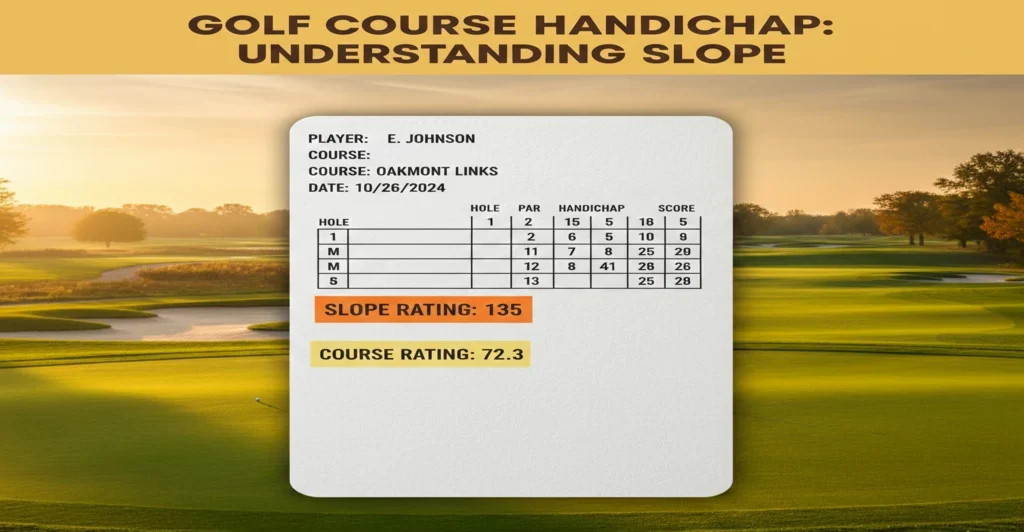
Definition:
A slope rating in golf measures how much more difficult a course plays for a bogey golfer compared to a scratch golfer.
It indicates the relative challenge of a course based on factors like hazards, length, terrain, and obstacles. Slope ratings range from 55 to 155, with 113 considered average.
If you’ve ever checked a scorecard or handicap chart and spotted a mysterious number labeled “Slope”, you’re not alone. Many golfers know their handicap but aren’t totally sure how slope rating shapes their score. Yet this single number quietly determines how fair your handicap is when you play different courses.
Let’s break it down in plain language so you can understand what slope rating means, why it matters, and how it affects your game every time you tee off.
What Is Slope Rating in Golf?
Slope rating is a course difficulty index designed to level the playing field among golfers of different skill levels. It tells you how challenging a course is for the average player compared to an expert.
Key Idea
- A higher slope rating = the course punishes mistakes more
- A lower slope rating = the course is more forgiving
This system is part of the official handicap framework administered by organizations like the United States Golf Association and The R&A.
Why Slope Rating Exists
Not all golf courses are created equal. A score of 90 at one course might reflect stronger play than a score of 85 at another. Slope rating ensures that handicaps adjust fairly depending on where you play.
Without slope rating:
- Handicaps would not reflect course difficulty
- Competitions across different courses would be unfair
- Scores would be misleading when compared
Slope rating makes golf scoring portable and comparable across courses worldwide.
The Origin of Slope Rating
The concept was introduced in the late 20th century as part of modern handicap reform. Golf’s governing bodies sought a more accurate way to evaluate course difficulty for non-elite players.
Previously, course rating only measured difficulty for scratch golfers (highly skilled players who shoot around par). But most golfers are not scratch players. Slope rating filled that gap by evaluating how a course challenges average golfers.
Today, slope rating is a standard part of course evaluation across many countries.
Understanding the Numbers
Slope rating always appears as a number between 55 and 155.
Interpretation Guide
| Slope RatingDifficulty LevelWhat It Means | ||
|---|---|---|
| 55–85 | Very easy | Forgiving layout, minimal hazards |
| 86–112 | Easier than average | Moderately forgiving |
| 113 | Standard difficulty | Benchmark course |
| 114–130 | Difficult | Penalizes mistakes |
| 131–155 | Extremely difficult | Major challenge for average players |
The number 113 represents a course of “standard” relative difficulty.
Slope Rating vs Course Rating
These two terms appear together but measure different things.
Quick Comparison
| Feature | Slope Rating | Course Rating |
|---|---|---|
| Measures difficulty for | Average golfer vs scratch golfer | Scratch golfer only |
| Scale | 55–155 | Around par value |
| Purpose | Adjust handicap strokes | Estimate expected score |
| Focus | Relative challenge | Absolute difficulty |
Simple Explanation
- Course rating = how hard the course is for experts
- Slope rating = how much harder it gets for regular golfers
Both numbers work together to calculate your course handicap.
How Slope Rating Affects Your Handicap
Slope rating directly influences how many strokes you receive on a given course.
Basic Concept
When slope rating is higher:
- Your course handicap increases
- You receive more strokes
When slope rating is lower:
- Your course handicap decreases
- You receive fewer strokes
This adjustment keeps competition fair across different courses.
Real-World Example
Imagine two courses with the same par but different slope ratings.
Example Scenario
| Course | Par | Slope Rating | Result for Average Golfer |
|---|---|---|---|
| Course A | 72 | 113 | Standard challenge |
| Course B | 72 | 140 | Much harder course |
Even though both courses have identical pars, Course B is significantly more difficult for most golfers.
Your handicap adjusts to reflect this difference.
What Makes a Course Have a High Slope Rating?
Courses with higher slope ratings usually include features that punish imperfect shots.
Common Factors
- Narrow fairways
- Deep bunkers
- Water hazards
- Thick rough
- Long carry distances
- Severe greens
- Elevation changes
- Strategic course design
These elements disproportionately challenge average players more than experts.
Step-by-Step: How Slope Rating Is Determined
Course rating teams evaluate each hole and assign difficulty values based on standardized criteria.
Evaluation Process
- Measure total course length
- Analyze obstacles and hazards
- Evaluate terrain and landing zones
- Compare impact on scratch vs bogey golfers
- Calculate final slope number
The result reflects how much harder the course is for the typical golfer.
How Golfers Use Slope Rating
Slope rating appears on:
- Scorecards
- Handicap charts
- Course websites
- Tournament rules
- Golf apps
Practical Uses
✔ Adjusting handicap for competition
✔ Comparing course difficulty
✔ Planning strategy before play
✔ Tracking performance across courses
Many golfers check slope rating before choosing which tees to play.
Tone and Usage Examples
Slope rating is typically used in neutral, informational contexts, but tone can vary.
Neutral
“This course has a slope rating of 128.”
Enthusiastic
“That course plays tough slope rating 142!”
Concerned
“With a slope that high, I’m playing from forward tees 😅”
Common Misconceptions
Myth: Higher slope means longer course
Reality: Length matters, but hazards and design are bigger factors.
Myth: Slope rating measures difficulty for all golfers equally
Reality: It measures difficulty relative to skill level.
Myth: Only professionals care about slope rating
Reality: It matters most for average golfers.
Alternate Meanings of “Slope” in Golf
While “slope rating” has a specific technical meaning, the word “slope” can also refer to:
- The tilt of a putting green
- The angle of terrain
- Shot trajectory (informal usage)
However, slope rating always refers to course difficulty within the handicap system.
Professional Alternatives and Related Terms
If you want to describe slope rating in different ways:
- Course difficulty index
- Handicap adjustment factor
- Relative course challenge
- Bogey golfer difficulty rating
These are explanatory phrases rather than official terms.
Why Slope Rating Matters for Everyday Golfers
Even if you’re not competing, slope rating helps you:
- Understand why scores vary by course
- Choose appropriate tees
- Track real improvement
- Compete fairly with friends
- Interpret handicap adjustments
It’s essentially the fairness engine behind modern golf scoring.
FAQs:
What does slope rating measure in golf?
It measures how much more difficult a course is for an average golfer compared to a scratch golfer.
What is considered a normal slope rating?
113 is the standard average slope rating.
Is a higher slope rating harder?
Yes. The higher the number, the more difficult the course is for most golfers.
Does slope rating affect your score?
It doesn’t change the strokes you take but it affects how your handicap is applied.
Can two courses have the same par but different slope ratings?
Yes. Course design and hazards create differences in difficulty.
Who calculates slope ratings?
Official golf rating teams authorized by governing bodies evaluate courses.
Do beginners need to worry about slope rating?
Yes, especially when calculating your course handicap or choosing tees.
What is the highest possible slope rating?
155 is the maximum allowed rating.
Conclusion
So, what does slope rating mean in golf? It’s the number that tells you how much tougher a course becomes for everyday golfers compared to experts. More than just a statistic, it’s the system that makes handicaps fair, competitions balanced, and scores meaningful across different courses.
Next time you check a scorecard, don’t skip that number. It quietly explains why some rounds feel easy, others feel brutal, and how your performance truly compares.
Understanding slope rating isn’t just golf knowledge it’s smarter golf.
Discover More Related Articles:
- PFP Mean in Text: Complete Guide for Social Media Users (2026)
- Shabbat Shalom Mean in English: Usage, and Significance in 2026

Sarah Williams is the passionate author behind WordNexy.com, dedicated to creating content that informs, inspires, and sparks curiosity. With a love for words and storytelling, she transforms ideas into meaningful articles that educate, entertain, and leave a lasting impression on every reader.

