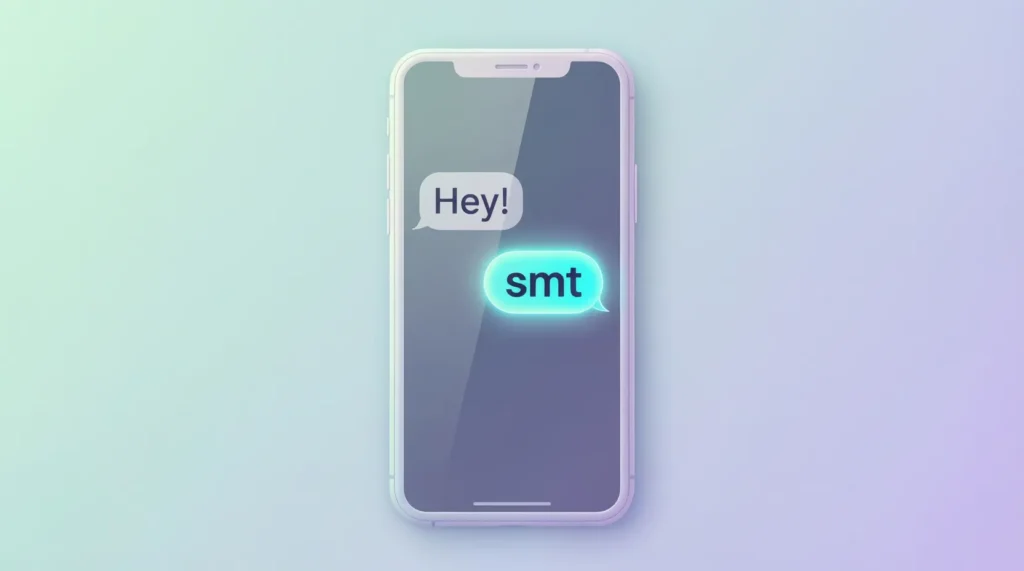
SMT in text messages most commonly means “something.” It is an informal abbreviation used in casual texting and online conversations to save time and type faster.
If you have ever received a message like “I want to tell you smt” or “Can we do smt later?” and felt confused, you are not alone. Text slang changes quickly, and abbreviations like SMT Text Meaning can be hard to understand if you are not familiar with them.
In this detailed guide, you will learn exactly what SMT means in text, where it comes from, how people use it in real conversations, what tone it carries, and when it is appropriate to use it. We will also compare it with similar abbreviations, share polite alternatives, and answer the most common questions people search online.
What Does SMT Mean in Text?
In most texting and social media conversations:
SMT = Something
It is simply a shortened version of the word something and is mainly used in informal writing.
Simple Example
“I need to tell you smt important.”
Meaning: “I need to tell you something important.”
People often use SMT in fast conversations when they want to type quickly without worrying about perfect grammar.
Origin of SMT in Texting
The abbreviation SMT developed naturally with the rise of mobile texting and online chat platforms.
Why SMT Became Popular
Typing the full word something takes time
Early SMS had character limits
Chat culture favors speed and simplicity
People prefer short forms in casual conversation
As texting became more common, abbreviations like SMT became a normal part of digital language.
How Popular Is SMT Today?
SMT is still commonly used, especially among younger users and frequent texters.
It is popular on platforms like:
WhatsApp
Instagram DMs
Snapchat
Discord
SMS messages
It is less common in:
Emails
Office communication
Academic writing
Professional settings
How SMT Is Used in Real Conversations
SMT is usually placed exactly where the word something would appear in a sentence.
Common Sentence Patterns
“I need smt from you.”
“There is smt wrong.”
“Let’s do smt fun today.”
“She told me smt yesterday.”
The meaning stays the same as the full word. Only the length changes.
Tone of SMT in Text Messages
The word SMT itself is neutral. The tone depends on how and where it is used.
Friendly Tone
“I got you smt nice 😊”
“Let’s plan smt fun!”
Neutral Tone
“She mentioned smt about work.”
“I forgot smt at home.”
Vague or Dismissive Tone
“He said smt, I don’t remember.”
“It’s smt like that.”
The surrounding words decide whether the message feels warm, neutral, or distant.
Examples of SMT in Text With Context
Friendly Examples
“I bought smt for you 🎁”
“Let’s do smt special tonight.”
Neutral Examples
“I heard smt about the meeting.”
“There is smt you should know.”
Vague or Dismissive Examples
“He said smt, not sure what.”
“It’s smt like that, don’t worry.”
Example
| Text Message | Full Meaning | Tone |
|---|---|---|
| I want to tell you smt | I want to tell you something | Neutral |
| Let’s do smt cool | Let’s do something cool | Friendly |
| There is smt wrong | There is something wrong | Serious |
| He said smt, idk | He said something, I don’t know | Dismissive |
| I got smt for you | I got something for you | Warm |
Where SMT Is Commonly Used
SMT is mostly seen in informal digital communication.
Common Places
Private chats
Group messages
Social media DMs
Online comments
Rarely Used In
Formal emails
Professional documents
School assignments
Business communication
SMT Compared With Similar Abbreviations
SMT vs STH
Both mean something
SMT is more casual
STH looks slightly more traditional
SMT vs SMTH
Both have the same meaning
SMT is shorter
SMTH is clearer for some readers
SMT vs Other Slang
SMT does not mean IDK, TBH, or BTW
It only replaces the word something
Alternate Meanings of SMT
In casual texting, SMT almost always means something.
However, in technical fields it can mean other things.
Possible alternate meanings:
Surface Mount Technology
Simultaneous Multithreading
Statistical Machine Translation
These meanings are used only in technical or professional contexts, not everyday texting.
Is SMT Rude or Informal?
SMT is informal but not rude.
It may sound:
Too casual in professional settings
Lazy if overused
Confusing for people unfamiliar with slang
If clarity matters, it is better to write the full word something
Polite and Professional Alternatives to SMT
Polite Alternatives
Something
An idea
A thing
A matter
Professional Alternatives
A detail
An item
A concern
A request
Example
Casual: “I want to discuss smt.”
Professional: “I would like to discuss something important.”
When Should You Use SMT?
Use SMT When
Chatting with friends
Sending casual messages
Replying quickly
Talking informally
Avoid SMT When
Writing emails
Talking to your boss
Communicating with clients
Writing formal content
FAQs
What does SMT mean in texting?
SMT means something in casual text messages.
Is SMT slang?
Yes, SMT is informal texting slang.
Is SMT the same as SMTH?
Yes, both mean something.
Can SMT sound rude?
Not usually. Tone depends on context.
Is SMT used on Instagram and Snapchat?
Yes, it is common in DMs and chats.
Should I use SMT at work?
No, use the full word something in professional settings.
Does SMT have multiple meanings?
Only in technical fields, not in texting.
Is SMT still used today?
Yes, especially in casual online conversations.
Conclusion
SMT is a simple and commonly used texting abbreviation that means something. It helps people communicate faster in informal chats and social media messages. While it is not rude, it should be avoided in professional or formal situations.
If you understand how and when to use SMT, you can read messages more confidently and choose the right tone when replying. When in doubt, writing the full word something is always a safe choice.
Search More Related Articles :
- RSVP Meaning in English: Complete Guide with Origin and Examples (2026)
- What Does LOI Stand For in Business Transactions? (2026)

Amanda Lewis is a professional content writer and word-meaning researcher who specializes in explaining definitions, slang, abbreviations, and modern language terms. She writes for WordNexy.com, where she creates clear, accurate, and reader-friendly articles to help users understand word meanings and proper usage. Her work is especially useful for students, writers, and online readers seeking quick and reliable explanations.