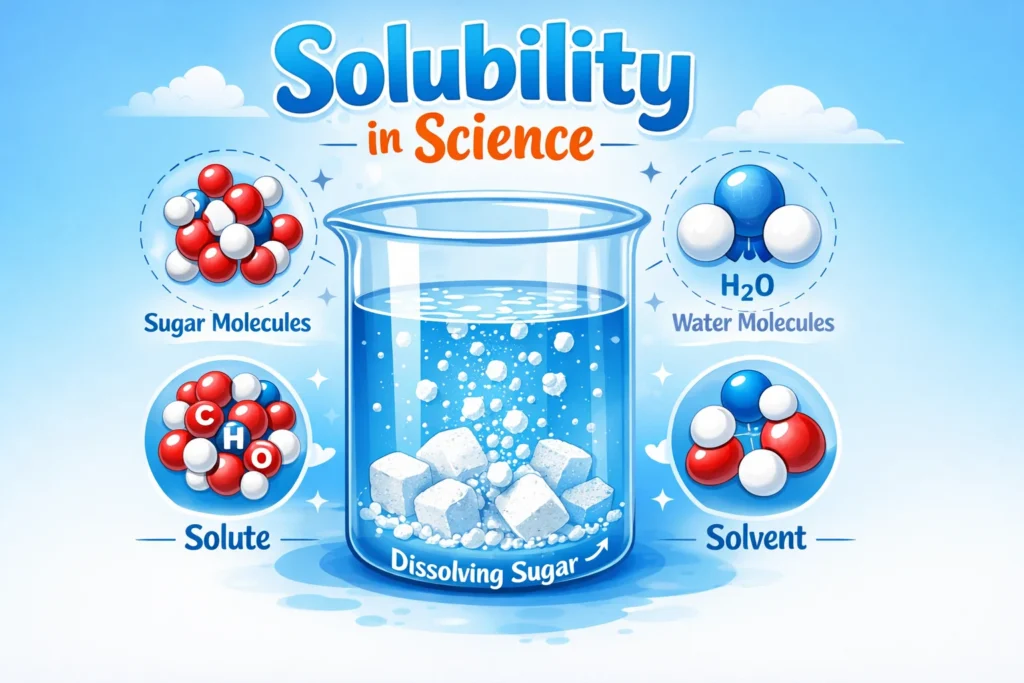
Definition:
Solubility in science refers to the ability of a substance, known as the solute, to dissolve in a solvent to form a homogeneous mixture called a solution. Simply put, it measures how much of a substance can mix evenly with a liquid without leaving any residue.
Have you ever stirred sugar into tea or salt into water and wondered why some substances dissolve easily while others just sit at the bottom? That’s the essence of solubility an essential concept in chemistry, biology, environmental science, and even everyday life! Understanding solubility not only explains why some things mix while others don’t, but also has real-world applications in medicine, cooking, water treatment, and industry.
Origin of the Term “Solubility”
The word solubility comes from the Latin solubilis, meaning “capable of being dissolved.” It has been a fundamental concept in chemistry since the 18th century, becoming widely discussed during the growth of analytical chemistry and pharmacology. Scientists and educators popularized the term because understanding how substances interact with solvents is key to chemical reactions, formulation of medicines, and industrial processes.
How Solubility Works: The Science Behind It
At its core, solubility is about the interaction between particles:
- Solute: The substance that dissolves (e.g., salt, sugar).
- Solvent: The medium in which the solute dissolves (commonly water).
- Solution: The final homogeneous mixture.
When a solute dissolves, its molecules separate and become evenly distributed in the solvent. This process is influenced by:
- Temperature: Generally, solids dissolve better in warmer liquids, while gases dissolve better in colder liquids.
- Pressure: Especially for gases, higher pressure increases solubility.
- Nature of the solute and solvent: Polar solutes dissolve in polar solvents (like salt in water), while nonpolar solutes dissolve in nonpolar solvents (like oil in hexane).
💡 Tip: Remember the chemistry saying: “Like dissolves like.” It helps predict whether a substance will dissolve in a particular solvent.
Real-World Usage of Solubility
Solubility isn’t just a lab concept it’s everywhere:
- Cooking: Sugar dissolving in tea or salt dissolving in soup.
- Medicine: Drugs must be soluble in body fluids to be effective. Poor solubility can reduce bioavailability.
- Environmental science: Pollutants’ solubility in water determines how they spread and their ecological impact.
- Industry: Solubility is crucial in making paints, dyes, cosmetics, and cleaning agents.
Example: When you dissolve table salt in water, the ions separate and disperse evenly, creating a saline solution perfect for cooking or even medical use.
Examples of Solubility in Science
Here’s a quick table showing common solutes and their solubility behavior in water at room temperature (25°C):
| Solute | Solubility in Water | Notes / Context |
|---|---|---|
| Table Salt (NaCl) | 36 g per 100 mL | Easily dissolves; essential in cooking |
| Sugar (Sucrose) | 211 g per 100 mL | Very soluble; sweetens beverages |
| Oil (Vegetable) | Insoluble | Forms separate layer; nonpolar |
| Carbon Dioxide (CO₂) | 1.45 g per L | Solubility increases under pressure; fizzy drinks |
| Baking Soda (NaHCO₃) | 9.6 g per 100 mL | Soluble; used in baking and cleaning |
| Sand (SiO₂) | Insoluble | Remains at the bottom; non-reactive |
✅ Fun Fact: Some substances are only partially soluble like chocolate in cold milk. Heat increases solubility, explaining why hot chocolate mixes better.
Factors Affecting Solubility
- Temperature: Higher temperature usually increases solubility of solids, but decreases solubility of gases.
- Pressure: For gases, higher pressure increases solubility (e.g., carbonated beverages).
- pH Level: Acidic or basic conditions can alter solubility of certain salts and compounds.
- Nature of Solute and Solvent: Polar-polar or nonpolar-nonpolar combinations dissolve best.
📌 Pro Tip: Solubility curves (graphs of solubility vs. temperature) are a handy visual tool for predicting how much solute can dissolve at different temperatures.
Comparison with Related Terms
- Saturation: The point at which no more solute can dissolve in a solvent at a given temperature.
- Supersaturation: When more solute is dissolved than theoretically possible, often unstable.
- Solvent Capacity: The maximum amount a solvent can dissolve.
- Dissolution: The actual process of solute mixing with solvent; solubility is the measure of how much can dissolve.
Example: Saltwater can be saturated with NaCl. If more salt is added, it will simply settle at the bottom indicating the solution is saturated.
Alternate Meanings of Solubility
Although mostly used in chemistry and science:
- Figurative Meaning: Sometimes “solubility” is used metaphorically to describe something that blends or adapts easily, e.g., “The plan’s solubility in the company culture was remarkable.”
- Business/Finance Context: Rarely, “solubility” may refer to liquidity or adaptability in corporate settings.
Polite and Professional Alternatives
If writing for formal contexts, instead of using “solubility” casually, you might consider:
- Dissolution rate (for pharmaceuticals and chemistry reports)
- Solvent compatibility (industrial or chemical engineering contexts)
- Mixing capacity (informal science education or teaching contexts)
FAQs
- What does solubility mean in simple terms?
Solubility is how much of a substance can dissolve in a liquid to make a uniform mixture. - What are examples of soluble substances?
Sugar, salt, baking soda, and many ionic compounds are soluble in water. - Why are some substances insoluble?
Insoluble substances have molecules that don’t interact well with the solvent (like oil in water). - Does temperature affect solubility?
Yes! Solids usually dissolve more at higher temperatures, while gases dissolve more at lower temperatures. - Can solubility be measured?
Absolutely. It’s usually expressed in grams of solute per 100 mL of solvent. - What is the difference between solubility and saturation?
Solubility is the maximum amount that can dissolve; saturation is the point when no more can dissolve. - Why is solubility important in medicine?
Drugs need to dissolve in body fluids to be absorbed effectively. Poor solubility can reduce effectiveness. - Is solubility only for liquids?
Mostly yes, but it can apply to gases dissolving in liquids and sometimes solids in solids (alloys).
Conclusion:
Solubility is a foundational concept that explains how and why substances dissolve to form solutions. In simple terms, it describes how much of a solute can dissolve in a solvent under specific conditions such as temperature and pressure.
From sugar dissolving in tea to medicines working effectively in the body, solubility plays a critical role in science and everyday life.
Practical Tip: If you want to make a solution more effective, consider temperature changes or using a different solvent compatible with the solute.
Discover More Related Articles:
- Understanding FIP in Baseball: Definition, Formula, and Uses (2026)
- TW in Jewelry Meaning: What It Really Stands For (2026)

Sarah Williams is the passionate author behind WordNexy.com, dedicated to creating content that informs, inspires, and sparks curiosity. With a love for words and storytelling, she transforms ideas into meaningful articles that educate, entertain, and leave a lasting impression on every reader.