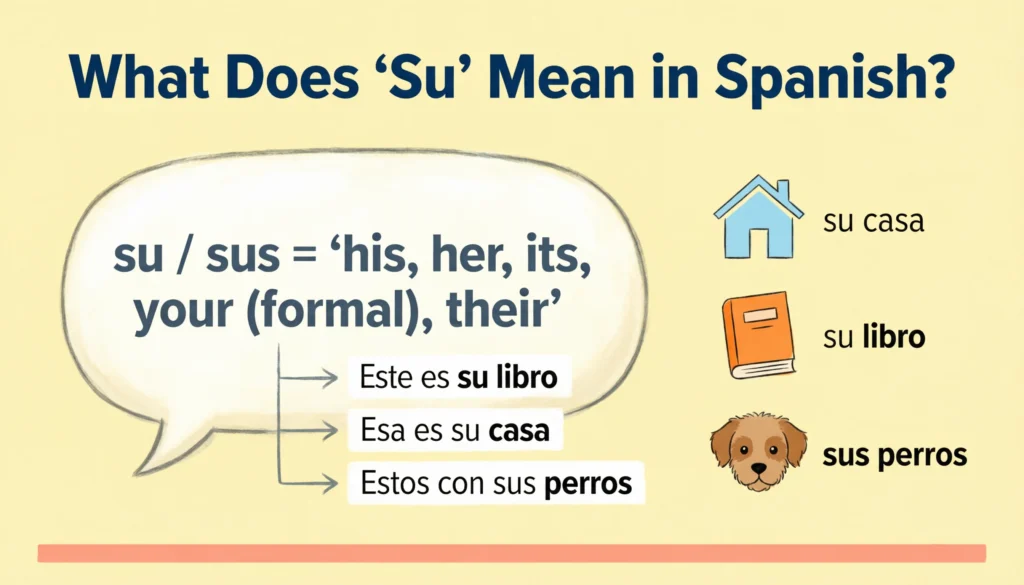
Definition:
In Spanish, “su” is a possessive adjective that translates to “his,” “her,” “its,” “their,” or the formal “your” (usted/ustedes). It is used to indicate ownership or association with a noun and must agree with the noun’s number (singular/plural) but not gender.
Origin of “Su” in Spanish
The word “su” has roots in Latin, derived from the term “sui,” which means “of himself/herself/itself/themselves.” Over centuries, as the Spanish language evolved from Latin during the medieval period, “su” became the standard way to indicate possession or association in both singular and plural contexts.
Its longevity and adaptability have made “su” one of the most commonly used words in Spanish. It appears frequently in formal and informal writing, conversation, literature, and official documents, making it essential for learners of Spanish to master.
How “Su” is Used in Spanish
“Su” functions as a possessive adjective and always precedes the noun it modifies. Unlike English, Spanish possessives do not always change according to gender of the owner, but they do agree with the number of the thing owned.
Basic Rules:
- Singular noun: su
- Plural noun: sus
Examples:
| Spanish | English | Context/Tone |
|---|---|---|
| Su casa es grande. | His/her/your (formal) house is big. | Neutral |
| Sus amigos llegaron temprano. | Their/your (formal) friends arrived early. | Neutral |
| Su libro está sobre la mesa. | His/her/your (formal) book is on the table. | Neutral |
| ¿Puedo hablar con su jefe? | Can I speak with your (formal) boss? | Polite/Formal |
Tip: Spanish speakers often clarify meaning by context or using phrases like “de él,” “de ella,” “de usted,” or “de ellos” if ambiguity exists. For example, “su libro” could mean his, her, your (formal), or their book.
Popularity and Real-World Usage
“Su” is incredibly common in Spanish-speaking countries due to:
- Its formal tone: Used in professional or respectful settings.
- Its versatility: Covers multiple possessive meanings in a single word.
- Its simplicity: Only one form for singular possession, easy for learners to remember.
You will encounter “su” in:
- Emails and letters (formal communication)
- Official documents (contracts, legal papers)
- Everyday conversation when referring respectfully to someone
Informal vs. Formal
In informal situations, Spanish speakers often use “tu” (your) or “tus” (your plural things) to indicate ownership instead of “su.”
- Example (informal):
- Tu coche es rápido. → Your car is fast.
- Example (formal):
- Su coche es rápido. → Your (formal) car is fast.
Examples of “Su” in Different Contexts
1. Friendly Tone:
- “Su sonrisa me alegra el día 😊.” → His/her smile brightens my day.
2. Neutral Tone:
- “Su trabajo es excelente.” → His/her/your (formal) work is excellent.
3. Negative or Dismissive Tone:
- “No me gusta su actitud.” → I don’t like his/her/your (formal) attitude.
4. Formal/Polite Situations:
- “Por favor, envíe su solicitud antes del viernes.” → Please submit your application by Friday.
5. Possession of Objects:
- “Sus zapatos están debajo de la cama.” → Their/your (formal) shoes are under the bed.
Comparison with Related Terms
| Term | Meaning | Usage Difference | Example |
|---|---|---|---|
| Su | His, her, its, your (formal), their | Singular possessive adjective | Su hermano es médico. → His/her/your (formal) brother is a doctor. |
| Sus | Their, your (formal) | Plural possessive adjective | Sus hijos estudian inglés. → Their/your (formal) children study English. |
| Tu / Tus | Your (informal) | Informal singular/plural possessive | Tu casa es bonita. → Your house is nice. |
| De él / De ella / De ellos | Of him, of her, of them | Used to clarify ownership when su is ambiguous | El coche de él es rojo. → His car is red. |
Pro Tip: When teaching Spanish, language apps often emphasize the ambiguity of “su” and recommend clarifying context in early conversations.
Alternate Meanings
While “su” is primarily a possessive adjective, in some rare regional slang or internet usage, it can appear as:
- SU (acronym) for organizations or social media terms (less common, context-specific).
- In texting, context usually indicates possession rather than abbreviation.
For language learners, focusing on “su” as possessive is by far the most practical and universally applicable understanding.
Polite or Professional Alternatives
If you want to avoid ambiguity or elevate the formality, you can replace “su” with:
- “de usted” → Your (formal)
- “de él / de ella” → His/her
- “de ellos / de ellas” → Their
Examples:
- Su oficina → La oficina de usted (formal, polite)
- Su hermano → El hermano de él / de ella (clearer in writing or speech)
Example Table: “Su” in Context
| Spanish Sentence | English Translation | Tone / Context |
|---|---|---|
| Su perro es muy amigable. | His/her/your (formal) dog is very friendly. | Neutral |
| Sus hijos estudian francés. | Their/your (formal) children study French. | Neutral |
| No me gusta su actitud. | I don’t like his/her/your (formal) attitude. | Negative |
| Por favor, traiga su identificación. | Please bring your (formal) ID. | Polite / Professional |
| Su sonrisa ilumina la habitación. | His/her smile lights up the room. | Friendly / Positive |
FAQs
1. What is the difference between “su” and “tu”?
- Su is formal or plural; tu is informal singular.
- Example: Su casa (formal your house) vs. Tu casa (informal your house).
2. Does “su” indicate gender?
- No, su does not change with gender, only with singular/plural nouns.
3. Can “su” mean “their” in Spanish?
- Yes, su can indicate “their” or formal “your” depending on context.
4. How do I know if “su” means his, her, or your?
- Context usually clarifies. You can also rephrase using “de él,” “de ella,” “de usted,” or “de ellos.”
5. Is “sus” just the plural of “su”?
- Correct! Su is singular; sus is plural (e.g., sus amigos = their friends).
6. Can I use “su” in informal conversations?
- Typically, no. Informal settings usually prefer tu or tus.
7. Are there any common mistakes with “su”?
- Yes, beginners often confuse su with tu or fail to match sus with plural nouns.
8. Is “su” used in Latin American Spanish and Spain equally?
FAQs
1. What is the difference between “su” and “tu”?
- Su is formal or plural; tu is informal singular.
- Example: Su casa (formal your house) vs. Tu casa (informal your house).
2. Does “su” indicate gender?
- No, su does not change with gender, only with singular/plural nouns.
3. Can “su” mean “their” in Spanish?
- Yes, su can indicate “their” or formal “your” depending on context.
4. How do I know if “su” means his, her, or your?
- Context usually clarifies. You can also rephrase using “de él,” “de ella,” “de usted,” or “de ellos.”
5. Is “sus” just the plural of “su”?
- Correct! Su is singular; sus is plural (e.g., sus amigos = their friends).
6. Can I use “su” in informal conversations?
- Typically, no. Informal settings usually prefer tu or tus.
7. Are there any common mistakes with “su”?
- Yes, beginners often confuse su with tu or fail to match sus with plural nouns.
8. Is “su” used in Latin American Spanish and Spain equally?
- Yes, but in Latin America, usted (and therefore su) is used more often in polite speech.
Conclusion
Understanding “su” is essential for anyone learning Spanish, as it is one of the most versatile and frequently used possessive adjectives in the language. Whether you are speaking formally, writing professional emails, or describing ownership in everyday conversation, su and its plural form sus will appear constantly.
Practical Tip: Always consider the relationship and context when choosing su vs. tu it can make your Spanish sound polite, respectful, and fluent.
Discover More Related Articles:

Sarah Williams is the passionate author behind WordNexy.com, dedicated to creating content that informs, inspires, and sparks curiosity. With a love for words and storytelling, she transforms ideas into meaningful articles that educate, entertain, and leave a lasting impression on every reader.