
Submission in the Bible refers to the act of willingly yielding to God’s authority, guidance, or the rightful authority of others in a way that reflects humility, obedience, and reverence. It is a conscious choice to trust God’s plan and to live in harmony with His word.
Understanding Submission in the Bible
Submission is a central concept in the Bible, appearing in both the Old and New Testaments. It is often misunderstood as weakness or passivity, but biblical submission is actually a powerful expression of faith, obedience, and love.
Biblical submission involves:
- Respecting God’s authority over one’s life
- Yielding to spiritual guidance and instruction
- Harmonious relationships with family, church leaders, and society
Biblical submission is always voluntary and rooted in love, not fear or coercion.
Origin of the Concept

The concept of submission in biblical context originates from the Hebrew word “sharat” (to serve or minister) and the Greek word “hupotasso” (to arrange under, obey, or voluntarily yield).
Old Testament Examples: Submission often involved obeying God’s commandments and the laws He gave to Israel. Abraham’s willingness to trust God with Isaac (Genesis 22:1-18) shows ultimate submission.
New Testament Examples: Submission is highlighted in passages such as Ephesians 5:21: “Submit to one another out of reverence for Christ,” emphasizing mutual respect and humility.
Real-World Usage
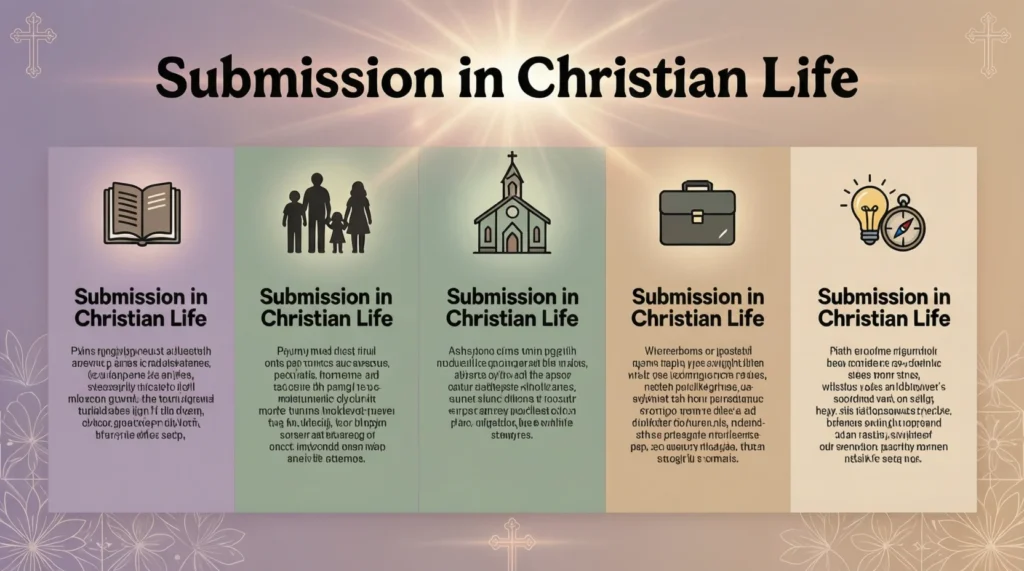
Submission in modern Christian life extends beyond theology; it shapes relationships, leadership, and personal growth.
Contexts of submission include:
- Spiritual Life: Obeying God’s word and following Christ’s teachings
- Family Life: Wives submitting to husbands, children to parents, in a framework of love and mutual respect (Ephesians 5:22-24, Colossians 3:20)
- Church Life: Respecting pastors, elders, and leaders while recognizing God as the ultimate authority
- Work and Society: Yielding to lawful authority as a reflection of godly obedience (Romans 13:1-2)
Biblical submission encourages discernment, prayer, and alignment with God’s word.
Examples
| Context | Biblical Example | Tone/Interpretation |
|---|---|---|
| Spiritual | Abraham offering Isaac (Genesis 22:1-18) | Reverent, trusting God’s plan 🙏 |
| Marital | Wives submitting to husbands (Ephesians 5:22-24) | Respectful, loving, mutual understanding 💕 |
| Leadership | Church members following elders (Hebrews 13:17) | Obedient but wise, voluntary 👍 |
| General Obedience | Citizens obeying government (Romans 13:1-7) | Respectful, lawful, neutral ⚖️ |
| Prayerful Submission | Jesus in Gethsemane (Matthew 26:39) | Humble, seeking God’s will 🙌 |
Tone Examples:
- Friendly/Positive: “Submitting to God’s plan brought peace and guidance.”
- Neutral/Instructional: “Submission ensures harmonious family and community life.”
- Cautionary/Negative Misuse: “Forced submission without love or understanding can lead to abuse or resentment.”
Comparison With Related Terms
| Term | Difference from Submission | Biblical Context |
|---|---|---|
| Obedience | Action-based; submission includes attitude and heart | Obedience: Ten Commandments; Submission: Ephesians 5:21 |
| Servitude | May involve compulsion; submission is voluntary | Servitude: slavery in Egypt; Submission: Christ-like humility |
| Respect | May not involve yielding; submission includes yielding authority | Respecting elders vs. submitting to elders (1 Peter 5:5-6) |
| Humility | Internal attitude; submission is outward action reflecting humility | Humble heart and outward submission (Philippians 2:3-4) |
Alternate Meanings and Contexts
Outside the biblical perspective, submission can have other connotations:
- General English: Yielding to another’s power or control
- Psychological/Interpersonal: Complying with someone’s wishes
- Negative Connotations: Can imply passivity, weakness, or oppression
Biblical submission is positive, voluntary, and rooted in love, not fear or coercion.
Polite and Professional Alternatives
For modern communication or teaching, alternative phrases can convey the biblical concept of submission without confusion:
- “Yielding to God’s will” 🙏
- “Respectful obedience” ✅
- “Mutual cooperation” 🤝
- “Humble service” 🌿
These alternatives maintain the spiritual and relational essence without sounding authoritarian.
Practical Tips for Practicing Biblical Submission
- Start with God: Submission begins with God first; aligning with His will strengthens all other relationships
- Mutual Respect: Submission should be paired with love and understanding
- Communicate Openly: Avoid misinterpretation by discussing expectations with care and wisdom
- Discern Wisely: Submission does not mean obeying harmful or sinful instructions; always test with Scripture
- Reflect Christ’s Example: Jesus submitted to God’s plan even under extreme pressure (Philippians 2:8)
FAQs
1. What does submission mean in the Bible for women?
It refers to a respectful, loving, and voluntary yielding to the husband’s leadership, reflecting mutual care and Christ-like humility (Ephesians 5:22-24).
2. Is submission the same as obedience?
Obedience is an action, while submission includes the attitude of the heart and willingness to yield to authority.
3. Can men practice submission?
Yes. Submission is for everyone, including mutual submission in marriage and church, and submission to God in all aspects of life (Ephesians 5:21).
4. Is submission forced in the Bible?
No. Biblical submission is voluntary, rooted in love and respect, never coercion.
5. How does submission relate to humility?
Humility is the inner attitude; submission is the outward expression of that humility in relationships and spiritual life.
6. What are the benefits of practicing submission?
Peaceful relationships, stronger faith, personal growth, and alignment with God’s will.
7. Can submission be misused?
Yes. When taken out of context, it can lead to abuse, manipulation, or unhealthy control. Always align with Scripture.
8. How do I teach submission to my children?
Model respect, explain the biblical purpose, and encourage voluntary cooperation, not fear-based compliance.
Conclusion:
Submission in the Bible is a powerful, life-giving principle rooted in love, humility, and trust in God rather than fear or weakness. At its core, biblical submission means willingly yielding to God’s authority first and then expressing that same Christ-like attitude in relationships with family, church, and society.
It is not blind obedience or forced control, but a voluntary choice guided by wisdom, Scripture, and mutual respect.
Submission is not weakness it is strength under God’s guidance. Embracing submission in a healthy, biblical way leads to peace, spiritual growth, and harmonious relationships.
Search More Related Articles:
- GBT Mean in Chat GPT :Explained for Students, Developers, and Users (2026)
- ASL Text Meaning: Definition and Modern Usage (2026)

Amanda Lewis is a professional content writer and word-meaning researcher who specializes in explaining definitions, slang, abbreviations, and modern language terms. She writes for WordNexy.com, where she creates clear, accurate, and reader-friendly articles to help users understand word meanings and proper usage. Her work is especially useful for students, writers, and online readers seeking quick and reliable explanations.