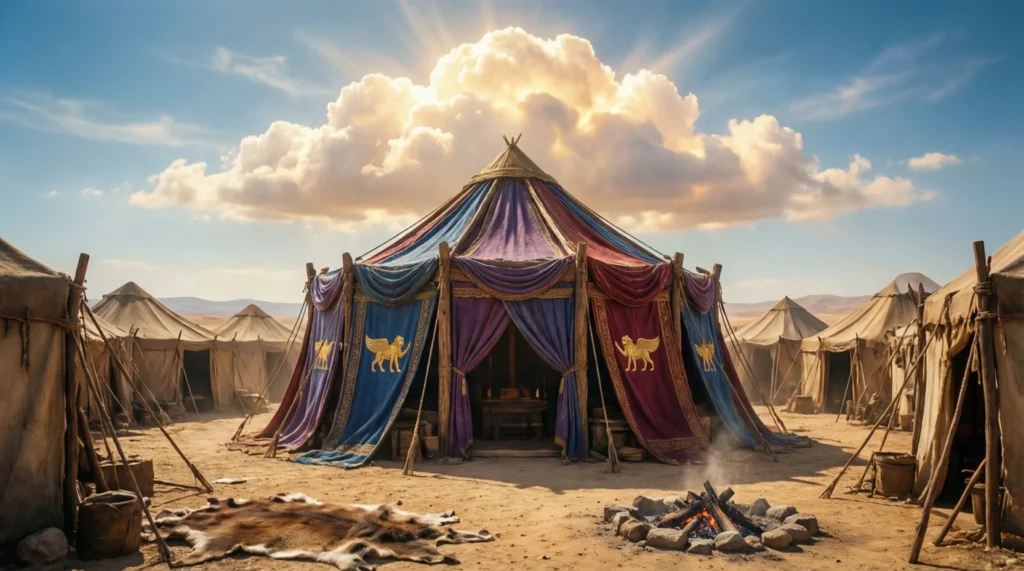
In the Bible, a tabernacle refers to a portable sanctuary or dwelling place where God’s presence resided among the Israelites during their journey through the wilderness.
It was a sacred space for worship, sacrifices, and communication with God, symbolizing His guidance, protection, and holiness.
The term “tabernacle” often evokes images of reverence, spiritual focus, and divine connection, making it one of the most significant concepts in biblical history. But what exactly does it mean, and why does it matter today? Let’s explore.
Origin of the Tabernacle
The concept of the tabernacle originates from the Hebrew word “Mishkan” (מִשְׁכָּן), meaning “dwelling place.” In the Old Testament, God instructed Moses to build the tabernacle as a sacred tent to house the Ark of the Covenant and to serve as a central place of worship for the Israelites.
- Biblical Reference: Exodus 25–31 contains detailed instructions for its construction, including materials, dimensions, and layout.
- Purpose: It was designed to symbolize God’s presence and to allow the Israelites to worship Him in a structured, communal setting.
- Historical Context: Unlike permanent temples, the tabernacle was portable, allowing the Israelites to carry it throughout their 40-year journey in the wilderness.
Fun Fact: The tabernacle’s portability symbolized God’s constant guidance and presence in the lives of His people, a reminder that God moves with His followers wherever they go.
Structure and Components
Understanding the structure of the tabernacle helps grasp its significance:
| Component | Purpose | Biblical Reference |
|---|---|---|
| Outer Court | Area for sacrifices and offerings; accessible to all Israelites | Exodus 27:9-19 |
| Holy Place | Inner chamber for priests; contained the Table of Showbread, Lampstand, and Altar of Incense | Exodus 26:33 |
| Holy of Holies | Most sacred area; housed the Ark of the Covenant; only the High Priest could enter once a year | Exodus 26:33, Leviticus 16:2 |
| Ark of the Covenant | Contained the Ten Commandments; symbolized God’s covenant with Israel | Exodus 25:10-22 |
Biblical Usage and Symbolism
The tabernacle served multiple spiritual and symbolic purposes:
- God’s Presence: It was a physical representation of God dwelling among His people.
- Worship and Sacrifice: Central to Israelite religious life, it structured daily and annual worship.
- Holiness and Separation: The strict layout emphasized spiritual discipline, purity, and reverence.
- Foreshadowing Christ: In Christian theology, the tabernacle prefigures Jesus Christ as God’s ultimate dwelling among humans.
Example in Context:
When the Israelites camped at Mount Sinai, the tabernacle was erected in the center of the camp. Wherever it went, the cloud of God’s presence guided them (Exodus 40:36-38).
Modern Understanding and Real-World Usage
While the tabernacle is an ancient structure, its spiritual lessons remain relevant today:
- Church Architecture: Many modern churches reflect tabernacle principles with sanctuaries, altars, and sacred spaces.
- Personal Faith: Christians often view their hearts as a “personal tabernacle” where God can dwell.
- Metaphorical Usage: The word “tabernacle” can describe any sacred dwelling, whether in literature, worship, or daily reflection.
Example (Friendly Tone):
Think of your mind as a tabernacle—keep it clean, focused, and open to guidance.
Comparison with Related Terms
| Term | Meaning | Difference from Tabernacle |
|---|---|---|
| Temple | Permanent house of worship | Unlike tabernacle, it is stationary; the first temple was Solomon’s Temple |
| Synagogue | Jewish house of assembly | Focused on teaching and community rather than being a dwelling for God’s presence |
| Chapel | Small Christian worship space | Usually private and non-portable, lacking the symbolic portability of the tabernacle |
Alternate Meanings of Tabernacle
While primarily biblical, “tabernacle” can also mean:
- General Shelter: A tent or temporary dwelling
- Metaphorical Dwelling: Any space where sacred or important things are kept
- Figurative Spiritual Concept: Symbolizing God’s presence in everyday life
Polite alternatives when speaking in general conversation include “sacred tent,” “holy dwelling,” or simply “sanctuary.”
Examples with Context
- Friendly/Inspirational Tone:
Your heart can be a tabernacle—cherish and protect it as a dwelling for goodness and faith. - Neutral/Informative Tone:
The tabernacle was a tent-like structure, portable, and divided into the Holy Place and Holy of Holies. - Negative/Dismissive Tone (rare, caution advised):
Some critics see the tabernacle as merely an ancient tent, overemphasized in ritual.
FAQs
1. What is the main purpose of the tabernacle?
The tabernacle was built as a special place where God could dwell among the Israelites. It served as a center for worship, sacrifices, and spiritual connection with God.
2. Where is the tabernacle mentioned in the Bible?
The tabernacle is primarily described in the books of Exodus (chapters 25–31 and 40) and Leviticus (chapter 16), where God gives instructions for its construction and use.
3. Is the tabernacle the same as the Temple?
No. The tabernacle was portable and moved with the Israelites during their journey. The Temple, built later by Solomon, was a permanent structure in Jerusalem.
4. Who was allowed to enter the tabernacle?
Only priests could enter the Holy Place, and only the High Priest could enter the Holy of Holies, and that only once a year on Yom Kippur.
5. What did the tabernacle symbolize?
The tabernacle symbolized God’s presence, holiness, spiritual guidance, and His covenant with the Israelites. It was a physical reminder of God living among His people.
6. Why is it called a “tabernacle”?
The term comes from the Hebrew word “Mishkan,” which means dwelling or residence. It was God’s dwelling place among the Israelites.
7. Can “tabernacle” have non-religious meanings?
Yes. Beyond the Bible, it can refer to any temporary shelter, a sacred place, or even a metaphorical space where something valuable or holy is kept.
8. How is the tabernacle relevant today?
The tabernacle continues to inspire spiritual reflection, teaching the importance of creating sacred spaces, maintaining holiness, and keeping faith alive in everyday life.
Conclusion
The tabernacle in the Bible is much more than a historical tent; it is a powerful symbol of God’s presence, guidance, and holiness. From its detailed construction in the wilderness to its role in worship and spiritual discipline, the tabernacle teaches us about reverence, faith, and the importance of creating sacred spaces in our lives both physically and spiritually.
Today, the lessons of the tabernacle remain relevant. Whether reflected in modern church design, personal devotion, or the idea of our hearts as spiritual dwellings, the concept reminds us to cherish, protect, and invite the divine into our lives.
Search More Related Articles:

James Anderson is an experienced content writer and language researcher who focuses on explaining word meanings, definitions, slang terms, and modern expressions. He writes for WordNexy.com, where his articles are designed to provide accurate meanings, practical usage examples, and easy-to-understand explanations for readers worldwide.