
“Take heart” in the Bible means to find courage, hope, and strength in the midst of challenges by trusting in God’s promises and presence.
It is an encouragement to remain steadfast, confident, and spiritually resilient despite difficulties.
Have you ever come across the phrase “take heart” while reading the Bible and wondered what it truly means? It’s more than just an old-fashioned saying; it’s a call to courage and faith that transcends time.
In a world full of uncertainties, the Bible frequently uses this phrase to uplift believers, reminding them that hope, strength, and comfort are always available through God.
Whether you’re facing personal struggles, spiritual challenges, or simply need reassurance, understanding the biblical meaning of “take heart” can transform the way you respond to life’s trials. In this article, we’ll explore its origin, usage, examples, related terms, and practical applications.
Origin of “Take Heart” in the Bible

The phrase “take heart” is a translation of several Hebrew and Greek terms found in the Bible that carry the meaning of encouragement, courage, and inner strength.
- Old Testament (Hebrew Origin):
The Hebrew word chazaq (חָזַק) often appears in contexts that urge believers to “be strong” or “be courageous.” For example: “Be strong and take heart, all you who hope in the LORD.” – Psalm 31:24 Here, chazaq emphasizes spiritual resilience, not just physical bravery. - New Testament (Greek Origin):
In the New Testament, the Greek phrase tharseo (θαρσέω) is often translated as “take heart” or “be courageous.” For instance: “Take heart! It is I. Don’t be afraid.” – Matthew 14:27 Jesus uses it to reassure His disciples in times of fear, offering both comfort and divine courage.
This phrase has carried through centuries, becoming a timeless encouragement for people facing fear, uncertainty, or trials.
What “Take Heart” Means in Everyday Life
While the biblical context emphasizes faith and courage in God, the phrase “take heart” has also found its way into everyday English. Here’s how it can be understood:
| Context | Meaning | Example |
|---|---|---|
| Biblical | Encouragement to trust God and remain spiritually strong | “Take heart; God is with you in your troubles.” |
| Everyday | Finding courage or hope in difficult situations | “Take heart, the test results will come back fine.” |
| Motivational | Uplifting someone who is feeling discouraged | “Take heart! Every setback is a setup for a comeback.” |
Why “Take Heart” is Popular in the Bible

The popularity of “take heart” in scripture is rooted in its universality and simplicity.
- Universality: Anyone, regardless of age, background, or circumstance, can understand and internalize it.
- Timelessness: Fear, doubt, and uncertainty are timeless human experiences, making this phrase eternally relevant.
- Encouragement: It’s a gentle but powerful way to remind believers that they are not alone in their struggles.
The phrase is often paired with hope, reassurance, and divine presence, making it one of the Bible’s most comforting messages.
Biblical Examples of “Take Heart”
Here are some notable instances where “take heart” appears in the Bible:
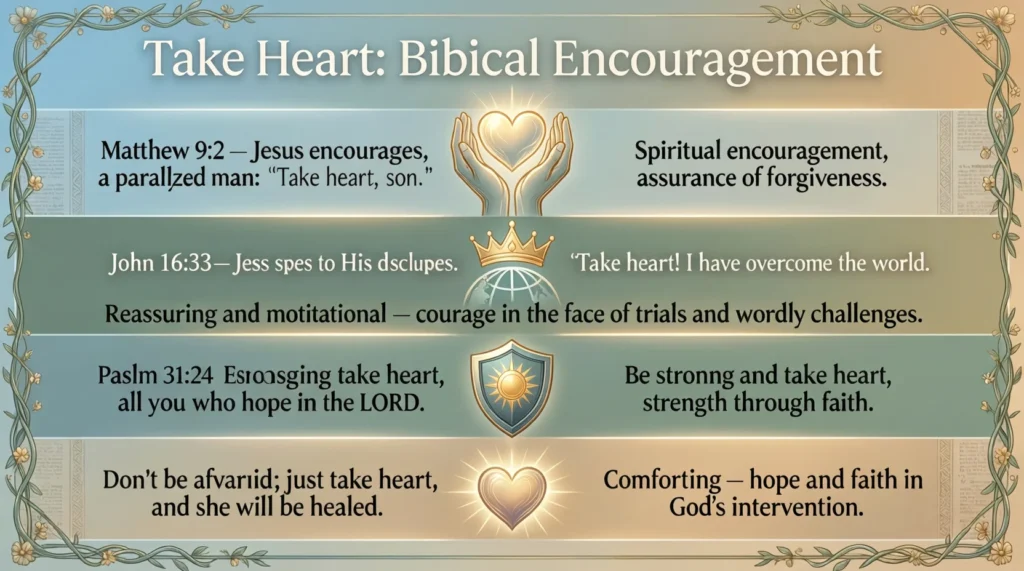
- Matthew 9:2 – Jesus encourages a paralyzed man: “Take heart, son; your sins are forgiven.”
- Tone: Friendly and compassionate
- Meaning: Spiritual encouragement, assurance of forgiveness
- John 16:33 – Jesus speaks to His disciples: “Take heart! I have overcome the world.”
- Tone: Reassuring and motivational
- Meaning: Courage in the face of trials and worldly challenges
- Psalm 31:24 – David’s message to God’s followers: “Be strong and take heart, all you who hope in the LORD.”
- Tone: Encouraging and hopeful
- Meaning: Strength through faith
- Luke 8:50 – Jesus reassures Jairus regarding his daughter: “Don’t be afraid; just take heart, and she will be healed.”
- Tone: Comforting
- Meaning: Hope and faith in God’s intervention
Tone and Usage in the Bible
Understanding the tone of “take heart” is crucial:
- Friendly: Jesus often uses it when addressing His disciples personally.
- Reassuring: It calms fears and provides confidence in God’s plan.
- Encouraging: It motivates believers to persist despite difficulties.
In modern usage, the tone may shift slightly depending on context:
- Neutral: General encouragement without spiritual context
- Motivational: Inspirational for challenges outside of faith
- Lighthearted: Sometimes used casually, e.g., “Take heart, it’s just a small mistake!”
Comparison with Similar Biblical Terms
The phrase “take heart” is similar to other biblical expressions that encourage courage and faith:
| Phrase | Meaning | Difference from “Take Heart” |
|---|---|---|
| Be strong | Urges strength, often physical or emotional | Focuses more on fortitude than hope |
| Be courageous | Encourages bravery in action | Emphasizes facing fear directly |
| Fear not / Do not be afraid | Directly addresses fear | Less about inner hope, more about removing fear |
| Be of good courage | Combination of courage and confidence | Closely aligned with “take heart” but slightly formal |
Alternate Meanings and Secular Usage
Outside the Bible, “take heart” can mean:
- Finding personal courage: Facing life challenges with a positive mindset
- Encouragement in work or school: Motivating others to continue despite setbacks
- Emotional resilience: Regaining confidence after disappointment
Example:
“Take heart! Even though you failed this time, every effort brings growth.”
Polite or Professional Alternatives
If you want to use a similar phrase in professional or formal contexts, consider:
- “Stay encouraged”
- “Remain confident”
- “Find strength in hope”
- “Be reassured”
These maintain the essence of the phrase without informal connotations.
Practical Tips for Applying “Take Heart” in Daily Life
- During Fear or Anxiety: Recall biblical examples to inspire courage.
- When Facing Failure: Remember it is about inner hope, not just external success.
- For Others: Offer the phrase as gentle encouragement, accompanied by supportive actions.
- In Prayer or Meditation: Use it as a mantra for spiritual resilience.
- Journaling: Write down moments where you “took heart” to track growth.
FAQs
1. Is “take heart” the same as being brave?
Not exactly. Being brave often focuses on action; “take heart” emphasizes inner courage, hope, and faith.
2. Which Bible verses mention “take heart”?
Common verses include Matthew 9:2, Matthew 14:27, John 16:33, Luke 8:50, and Psalm 31:24.
3. Can “take heart” be used in modern English?
Yes, it’s widely used to encourage someone in secular contexts as well.
4. Is there a Hebrew or Greek original for “take heart”?
Yes, chazaq (Hebrew) and tharseo (Greek) are often translated as “take heart” or “be courageous.”
5. How does “take heart” differ from “fear not”?
“Fear not” removes fear; “take heart” adds hope, courage, and encouragement.
6. Can “take heart” be used in writing or speeches?
Absolutely. It is a timeless, uplifting phrase suitable for sermons, motivational speeches, or personal letters.
7. Does “take heart” mean God will fix all problems?
Not necessarily. It encourages trust and courage, even when challenges remain.
8. Are there modern equivalents of “take heart”?
Yes, phrases like “stay encouraged,” “keep faith,” or “be confident” capture similar meanings.
Conclusion
In the Bible, “take heart” is more than a comforting phrase; it’s a divine invitation to courage, hope, and resilience. It encourages believers to trust in God’s presence and promises, regardless of life’s challenges. Beyond scripture, it serves as a timeless reminder to find inner strength, motivate others, and embrace hope in every situation.
By understanding its biblical context, tone, and practical applications, we can bring this phrase into our daily lives, offering both spiritual and emotional encouragement to ourselves and others.
Search More Related Articles :
- RSVP Meaning in English: Complete Guide with Origin and Examples (2026)
- What Does LOI Stand For in Business Transactions? (2026)

James Anderson is an experienced content writer and language researcher who focuses on explaining word meanings, definitions, slang terms, and modern expressions. He writes for WordNexy.com, where his articles are designed to provide accurate meanings, practical usage examples, and easy-to-understand explanations for readers worldwide.