
The number 10 in the Bible symbolizes completeness, divine order, and God’s law. It represents a sense of perfection in responsibility, structure, and moral authority, often appearing in contexts of commandments, trials, and spiritual lessons.
The number 10 is more than just a digit; it carries deep spiritual meaning in biblical texts, influencing the way believers understand God’s expectations, human responsibility, and divine completeness.
From the Ten Commandments to parables and symbolic references, this number echoes throughout scripture, offering guidance, encouragement, and insight into God’s plan.
Origin of the Number 10 in the Bible
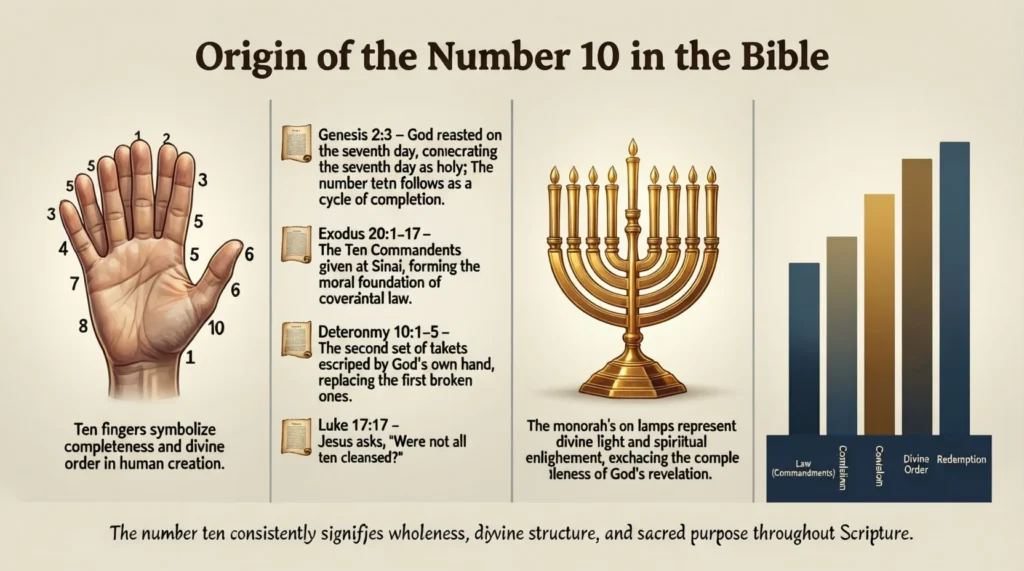
The number 10 holds its roots in ancient Hebrew culture, where numbers were often used symbolically rather than purely mathematically. In biblical numerology:
- 10 represents completeness or wholeness – it signifies the fullness of God’s law or a complete cycle of human responsibility.
- Origin in commandments – The most famous reference is the Ten Commandments, given to Moses on Mount Sinai (Exodus 20:1-17), which structured the moral and spiritual life of Israel.
- Cultural influence – Hebrew counting systems often used numbers symbolically to communicate spiritual truths, making 10 a recurring motif in teaching, prophecy, and storytelling.
In essence, the number 10 was both a practical numeral and a spiritual symbol, bridging daily life and divine guidance.
Biblical Usage and Popularity
The number 10 appears in multiple contexts in the Bible, showing its versatility and spiritual weight:
- Ten Commandments (Exodus 20) – A cornerstone of biblical law and morality.
- Ten Plagues of Egypt (Exodus 7–12) – A symbol of divine judgment and power.
- Tithes (Numbers 18:21) – A tenth part of produce or earnings given as an offering to God.
- Parables and teachings – Examples include the ten virgins (Matthew 25:1-13), highlighting preparedness and vigilance.
Why it’s popular:
- Represents divine order – God’s structure for living.
- Easily understood as a complete set – humans naturally think in tens (e.g., ten fingers).
- Recurring biblical stories give it memorability and significance.
Real-world usage:
Even today, Christians reference the number 10 in spiritual practices like tithing and in sermons to illustrate completeness or moral responsibility. Beyond faith, “top 10” lists and scoring systems in daily life subtly reflect this natural human attraction to the number 10.
Examples of the Number 10 in the Bible
Here’s a table of notable examples with context:
| Reference | Context | Meaning / Lesson |
|---|---|---|
| Exodus 20:1-17 | Ten Commandments | God’s law, moral completeness |
| Exodus 7–12 | Ten Plagues of Egypt | Divine judgment and power |
| Matthew 25:1-13 | Parable of the Ten Virgins | Preparedness and vigilance |
| Genesis 18:32 | Abraham negotiates over 10 righteous | Intercession and mercy |
| Numbers 18:21 | Tithing 1/10 of produce | Obedience and gratitude |
| Luke 17:12 | Ten lepers healed | Faith and gratitude |
| Revelation 2:10 | Ten days of testing | Perseverance in trials |
| Proverbs 10:1 | Ten sayings of wisdom | Instruction and learning |
Tone Examples:
- Friendly: “Think of 10 as God’s gentle nudge toward completeness—you’re not missing anything if you follow His guidance!”
- Neutral: “The number 10 appears frequently in scripture, often signaling moral or spiritual completeness.”
- Serious/Warning: “Ignoring the commandments, all ten of them, leads to consequences that the plagues of Egypt illustrate clearly.”
Comparison with Related Numbers
| Number | Meaning | Comparison to 10 |
|---|---|---|
| 3 | Divine completeness, Trinity | Spiritual perfection in God, but more focused on divinity than law |
| 7 | Completion, covenant | Symbolizes spiritual perfection; 10 is more about moral and practical completeness |
| 12 | Government, authority, tribes | Indicates organizational completeness; 10 is more about moral order |
| 40 | Testing, trial, probation | Periods of testing; 10 often precedes or marks completeness after trials |
Takeaway: The number 10 balances human responsibility and divine order, whereas numbers like 3, 7, and 12 often emphasize divine patterns or governance.
Alternate Meanings of the Number 10
While primarily representing completeness and law, 10 can also imply:
- Testing and trial: Ten plagues, ten days of testing.
- Responsibility or stewardship: Ten percent tithe signifies accountability to God.
- Preparation: Parable of the ten virgins teaches vigilance.
These alternate meanings enrich our understanding of how 10 functions symbolically beyond a simple numeric value.
Polite or Professional Alternatives
When discussing biblical numerology professionally:
- Use “symbolic significance of 10” instead of “magic number 10.”
- Reference “tenfold principles” in teaching contexts.
- Emphasize moral or spiritual lessons rather than mystical interpretations, keeping the discussion respectful and academically sound.
FAQs
- What does the number 10 represent in the Bible?
It represents completeness, moral order, and divine law, often associated with commandments and spiritual responsibility. - Why are the Ten Commandments so important?
They provide a complete moral and spiritual framework for humanity and reflect God’s standards. - Does the number 10 have negative meanings?
Occasionally, it symbolizes testing or judgment, like the ten plagues of Egypt, but primarily it is positive and instructive. - How is the number 10 used in tithing?
A tenth of one’s income or produce is given to God as an act of obedience and gratitude (Numbers 18:21). - What is the parable of the ten virgins?
A teaching in Matthew 25:1-13 about preparedness and spiritual vigilance. - Is the number 10 linked to spiritual completeness only?
Mostly, yes. It can also signify divine testing or human responsibility in biblical contexts. - Are there other numbers similar to 10 in symbolism?
Numbers like 3 (Trinity), 7 (spiritual perfection), and 12 (authority) serve related symbolic roles but focus on different aspects. - How can I apply the number 10 in daily spiritual life?
Consider it as a reminder of completeness, responsibility, and readiness to follow God’s guidance in daily actions.
Conclusion
The number 10 in the Bible is far more than a simple digit it is a powerful symbol of completeness, divine order, and spiritual responsibility. From the Ten Commandments to the parable of the ten virgins, this number reminds us of God’s guidance, the importance of moral integrity, and the value of being prepared and faithful.
Understanding the meaning of 10 can deepen your spiritual insight and help you apply biblical principles in everyday life. Whether through tithing, reflection, or following God’s laws, the number 10 encourages us to embrace wholeness, obedience, and vigilance.
By recognizing its significance, we can align our actions with God’s plan and cultivate a life of balance, responsibility, and spiritual completeness.
Discover More Related Articles:

Amanda Lewis is a professional content writer and word-meaning researcher who specializes in explaining definitions, slang, abbreviations, and modern language terms. She writes for WordNexy.com, where she creates clear, accurate, and reader-friendly articles to help users understand word meanings and proper usage. Her work is especially useful for students, writers, and online readers seeking quick and reliable explanations.