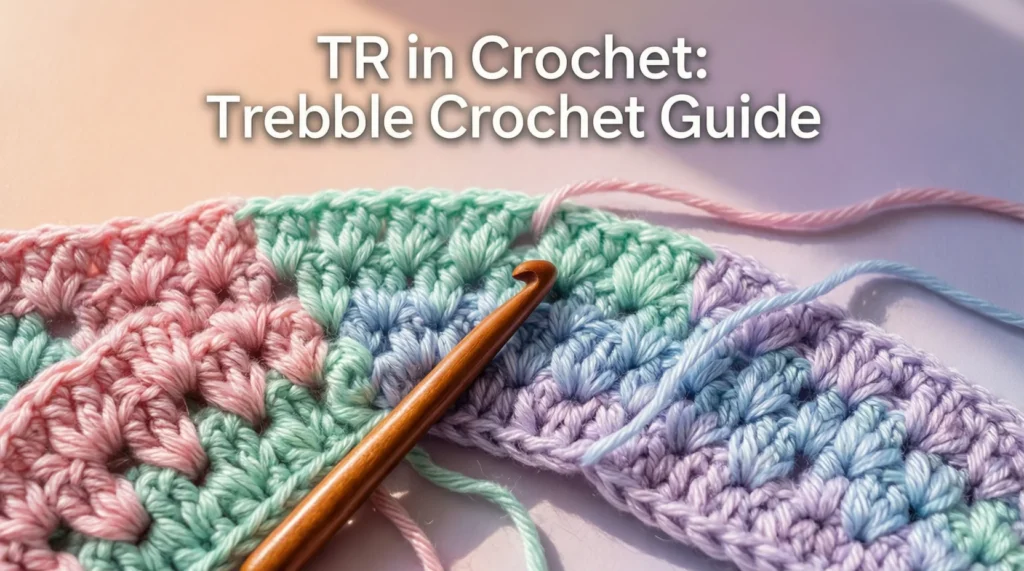
If you’ve ever picked up a crochet pattern and seen abbreviations like TR in Crochet Patterns, you’re not alone. Crochet patterns often use shorthand to save space, but to beginners, it can feel like decoding a secret language. Among these abbreviations, TR (treble crochet) is one of the most commonly used stitches, adding height and elegance to your projects.
Definition:
In crochet, TR stands for “treble crochet” (also called “triple crochet” in some regions). It is a tall stitch that creates an open, airy texture, perfect for blankets, shawls, and decorative patterns. Treble crochet involves wrapping the yarn twice around the hook before inserting it into the stitch, resulting in a taller stitch than a double or single crochet.
Whether you’re creating a lacy shawl, a vibrant blanket, or a delicate scarf, mastering TR is essential. This guide will explain what TR means in crochet, how to work it, its variations, and how it compares to other stitches. We’ll also provide examples, tips, and FAQs so you can confidently use TR in your next project.
Origin of TR in Crochet
The treble crochet stitch has roots in European crochet traditions. Early patterns, especially in Victorian England, relied heavily on tall stitches to create intricate lacework. The abbreviation TR comes from British and American crochet terminology:
- UK Crochet: TR is called triple crochet
- US Crochet: TR is called treble crochet
Its popularity grew with the rise of pattern books in the 19th and 20th centuries, making TR a staple in crochet vocabulary. Today, it is standard in both hand-written and digital patterns.
How TR Is Used in Crochet
Advantages of TR:
- Speeds up project completion due to its height
- Adds texture and dimension
- Works well with both thin and thick yarns
How to Work a TR Stitch Step by Step
For beginners, understanding the technique is essential. Follow these steps:
- Yarn over twice – Wrap the yarn around the hook two times
- Insert hook into stitch – Choose the stitch where you want the TR
- Yarn over and pull through – Pull the yarn through; you now have four loops on the hook
- Yarn over and pull through first two loops – You now have three loops remaining
- Yarn over and pull through two loops twice – Finish the stitch, leaving one loop on the hoo
Examples
Here are some scenarios where you might see TR used:
| Context | Example Pattern Line | Note |
| Friendly | “Ch 5, TR in next st, repeat across” | Encouraging beginners |
| Neutral | “TR 3 in same st for fan pattern” | Standard instructional tone |
| Practical Tip | “Avoid TR in tight spaces—it stretches” | Helpful caution |
Comparison: TR vs Other Common Crochet Stitches
Understanding how TR differs from other stitches helps you choose the right one:
| Stitch | Abbreviation | Height | Yarn Overs | Use Case |
| Single Crochet | SC | Short | 0 | Dense, firm fabric |
| Half Double Crochet | HDC | Medium | 1 | Balanced, versatile |
| Double Crochet | DC | Taller | 1 | Lightweight, faster |
| Treble Crochet | TR | Tallest | 2 | Open, airy, decorative |
Insight: TR is taller than DC, creating more openwork. Perfect when you want your project to feel lightweight or have decorative gaps.
Alternate Meanings of TR in Crochet
While TR almost always refers to treble crochet, it can occasionally appear in:
- Regional pattern books: TR may mean “triple crochet” (UK vs US terminology)
- Project-specific shorthand: Rarely, some designers use TR for “turn row” in notes
Advice: Always check the pattern key. Most modern patterns include a clear abbreviation list.
Polite or Professional Alternatives
When teaching or writing for beginners:
- Instead of “TR,” say “treble crochet” aloud
- Write it out fully in beginner tutorials: “Make a treble crochet in the next stitch”
Conclusion
Understanding TR in crochet patterns opens the door to creating lighter, taller, and more elegant designs with ease. The treble crochet stitch adds height and texture, making it perfect for airy shawls, lace patterns, blankets, and decorative projects. Once you know that TR means Treble Crochet and remember the basic steps yarn over twice, insert the hook, and pull through in stages it becomes far less intimidating.
With a little practice, maintaining even tension and counting stitches will help your work look neat and professional. Paying attention to pattern instructions and gauge is also key, especially since treble crochet stitches are taller than most basic stitches. Overall, mastering TR stitches not only improves your skill level but also gives you more creative freedom in crochet patterns.
FAQs
- What does TR mean in crochet?
TR stands for treble crochet, a tall stitch created by wrapping the yarn twice around the hook before inserting it into the stitch. - How is TR different from DC?
TR is taller than double crochet (DC) and has two yarn overs instead of one, creating a more open fabric. - Can beginners learn TR easily?
Yes. Once you understand DC, TR is the next step. The key is managing tension and keeping loops even. - What is the UK vs US difference for TR?
In the UK, TR is called triple crochet. In the US, it’s treble crochet. The technique is the same. - Can TR be used in blankets?
Absolutely. TR creates height, making patterns faster to complete. - What yarn works best for TR?
Medium-weight yarn like worsted is versatile, but TR also works beautifully with lightweight yarn for lacy designs. - Are there common mistakes with TR?
Beginners often pull loops too tight or miscount yarn overs. Consistency is key. - Can TR be combined with other stitches?
Yes. TR can be mixed with SC, DC, HDC, and chains to create intricate textures and patterns.

James Anderson is an experienced content writer and language researcher who focuses on explaining word meanings, definitions, slang terms, and modern expressions. He writes for WordNexy.com, where his articles are designed to provide accurate meanings, practical usage examples, and easy-to-understand explanations for readers worldwide.