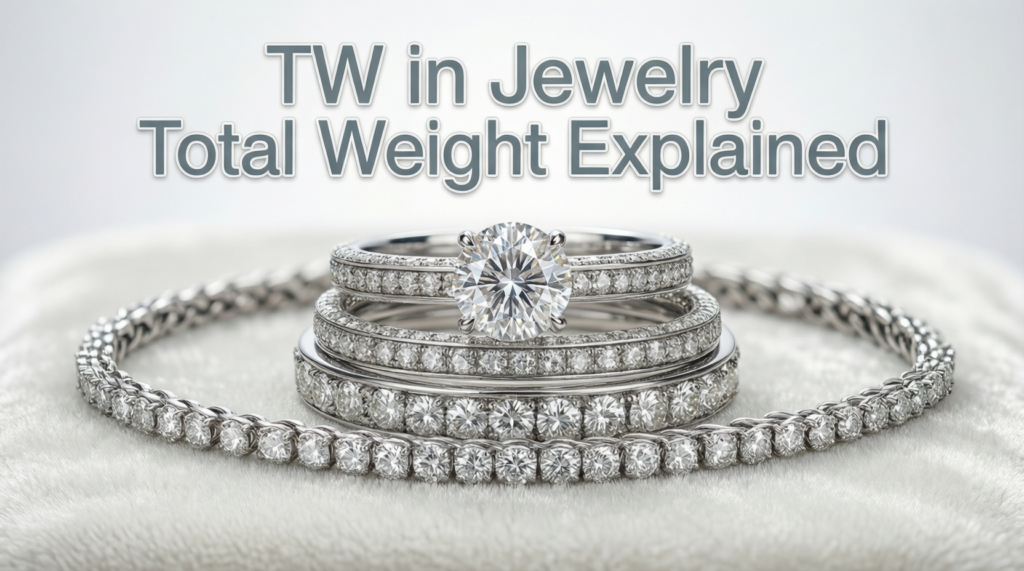
When shopping for jewelry, especially diamonds and gemstone pieces, you may have come across the abbreviation “TW” on a price tag or product description. But TW in Jewelry Meaning: What It Really Stands For (2026), and why is it important?
Understanding these small yet significant abbreviations can save you from confusion, help you make informed purchases, and even elevate your jewelry knowledge to an expert level.
Definition:
TW in jewelry stands for “Total Weight,” which refers to the combined weight of all diamonds or gemstones in a piece of jewelry, usually measured in carats.
In this guide, we’ll explore everything you need to know about TW, its origins, real-world usage, comparisons with related terms, examples, and tips to use it effectively when shopping or selling jewelry. Whether you’re a first-time buyer, a collector, or a jewelry enthusiast, this article will give you a clear and friendly explanation.
Origin of TW in Jewelry
The abbreviation TW originated in the jewelry industry as a practical shorthand used by jewelers to indicate Total Weight. In the early 20th century, as diamond and gemstone jewelry became more popular and detailed, jewelers needed a simple way to describe the combined weight of multiple stones in a single piece.
- TW = Total Weight
- Unit of measurement: Carats (ct) for diamonds and gemstones
- Purpose: Helps buyers understand the overall value and size of a jewelry item
Over time, TW became a standard notation in jewelry catalogs, online stores, and certificates, helping both jewelers and customers quickly grasp the total size of stones without listing each stone individually.
Why TW is Popular in Jewelry Descriptions
TW is widely used in rings, earrings, necklaces, and bracelets, particularly when a piece contains multiple stones of different sizes. Here’s why it matters:
- Clarity for Buyers: Instead of specifying each tiny diamond, TW sums up the total weight.
- Pricing Transparency: Diamonds are often priced per carat, so knowing the total carat weight helps gauge value.
- Comparison-Friendly: Buyers can compare pieces easily when total weight is provided.
- Certification Alignment: Lab reports and appraisals often reference TW, ensuring consistency.
For example, a pair of diamond stud earrings may be described as 0.50 TW, which means both earrings together have a total diamond weight of 0.50 carats.
How TW is Used in Jewelry
TW is commonly mentioned in product descriptions or jewelry certificates. It’s always associated with the carat weight of all stones combined.
Examples:
| Jewelry Piece | Description | TW Meaning |
| Engagement Ring | 1.25 CT TW | Total diamond weight of the ring is 1.25 carats |
| Diamond Stud Earrings | 0.75 CT TW | Combined weight of both diamonds is 0.75 carats |
| Tennis Bracelet | 5.00 CT TW | All diamonds in the bracelet add up to 5 carats |
Notice how TW gives a quick sense of scale, especially for pieces with multiple stones of varying sizes.
Understanding TW with Tone Context
When discussing jewelry, TW is typically neutral and factual. However, the tone can vary slightly depending on context:
- Friendly/Informative: “This beautiful diamond ring has 1.50 CT TW perfect for a special occasion! 💎”
- Neutral/Professional: “The bracelet features 3.00 CT TW, certified by GIA.”
- Dismissive/Confusing: “TW? Not sure why they even bother listing it, just look at the stones yourself.”
Understanding the tone helps when communicating about jewelry online or in person, ensuring clarity and professionalism.
TW vs. Other Jewelry Terms
It’s easy to confuse TW with similar abbreviations. Here’s a breakdown:
| Term | Meaning | Difference from TW |
| CT | Carat | Refers to the weight of a single stone, while TW sums all stones. |
| TWG | Total Weight of Gemstones | Similar to TW, sometimes used specifically for colored gemstones. |
| DWT | Pennyweight | A traditional unit of weight, rarely used today, mostly for precious metals. |
| TWT | Total Weight (another version) | Often interchangeable with TW but less common. |
💡 Tip: Always check whether the TW refers to diamonds only or all gemstones in the piece, as this can affect pricing and value.
Alternate Meanings of TW in Jewelry
While TW almost always stands for Total Weight, it’s worth noting that abbreviations can have other meanings in different contexts:
- TW Top Worn (rare, in fashion jewelry listings)
- TW Thread Weight (used in textiles, not jewelry)
However, in the jewelry world, TW nearly always refers to Total Weight, so there’s rarely room for confusion.
Professional Alternatives to TW
If you want to describe jewelry more formally or avoid using abbreviations:
- Total Carat Weight (CTW) Often preferred in formal catalogs.
- Combined Stone Weight Simple, plain-language alternative for non-jewelry audiences.
- Aggregate Carat Weight Technical term used in appraisals and lab reports.
These alternatives can make your descriptions more professional, especially for high-end jewelry, certifications, or marketing materials.
Examples
Here’s how TW might appear in real-world scenarios:
- Engagement Ring Listing:
“This stunning halo ring features a 0.75 CT center diamond and 0.50 CT TW for the surrounding stones, totaling 1.25 CTW.” - Earring Description:
“Classic diamond studs, 0.30 CT TW, perfect for everyday elegance.” - Tennis Bracelet Marketing:
“Add sparkle to your wrist with this 5.00 CT TW diamond tennis bracelet, certified for quality and brilliance.”
💡 Pro Tip: When comparing jewelry online, always check if TW is listed for each item individually (like a single earring) or combined (pair or set).
Comparison Table: TW vs. Similar Jewelry Terms
| Feature | TW (Total Weight) | CT (Carat) | CTW (Carat Total Weight) | DWT (Pennyweight) |
| Definition | Combined weight of all stones | Weight of one stone | Combined weight (synonym of TW) | Traditional weight unit for metals |
| Usage | Rings, earrings, bracelets | Single diamonds or gems | Same as TW, formal | Gold, silver, platinum |
| Unit | Carats (ct) | Carats (ct) | Carats (ct) | Pennyweight (dwt) |
| Clarity Indicated? | No | No | No | No |
Conclusion
In jewelry, TW stands for Total Weight, referring to the combined carat weight of all gemstones in a piece rather than a single stone. Understanding this term helps you compare jewelry more accurately, assess overall value, and avoid confusion when shopping.
By knowing what TW really means, you can make more informed decisions and choose jewelry that truly matches your style, budget, and expectations.
FAQs
1. Is TW the same as carat weight?
Yes and no. TW refers to the total weight of all stones combined, whereas carat usually refers to the weight of a single stone.
2. How do I calculate TW myself?
Add the carat weight of each stone in the piece. For example, a ring with three stones of 0.30, 0.20, and 0.25 carats has a TW of 0.75.
3. Does TW affect jewelry pricing?
Absolutely. Higher TW often means a higher price, as more gemstone material is used.
4. Are TW and CTW the same?
Yes, CTW (Carat Total Weight) is just another way to say TW.
5. Can TW include non-diamond stones?
Yes, TW can refer to all gemstones in a piece, not just diamonds. Always check the description.
6. Why don’t all jewelry listings include TW?
Some sellers may list individual stone sizes instead, especially for high-end or designer pieces.
7. Does TW indicate quality?
No. TW shows quantity (weight) but not the clarity, color, or cut of stones. Quality must be verified separately.
8. Is there a standard way TW is measured?
Yes, professional jewelers measure stones in carats and sum them for total weight, often reflected in certifications like GIA or AGS reports.

Amanda Lewis is a professional content writer and word-meaning researcher who specializes in explaining definitions, slang, abbreviations, and modern language terms. She writes for WordNexy.com, where she creates clear, accurate, and reader-friendly articles to help users understand word meanings and proper usage. Her work is especially useful for students, writers, and online readers seeking quick and reliable explanations.