Definition
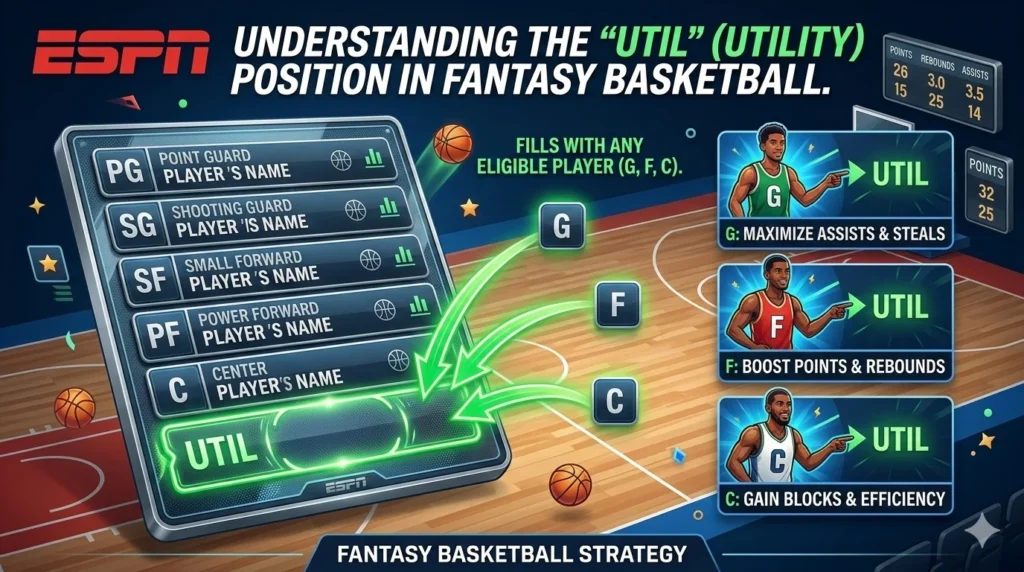
In fantasy basketball, UTIL stands for Utility. It is a flexible roster spot that allows managers to place any eligible player from any position into that slot. Unlike position-specific slots like PG (Point Guard) or C (Center), the UTIL position accepts players from multiple positions, giving fantasy managers more lineup flexibility.
Understanding the UTIL Position in Fantasy Basketball
What the Utility Slot Means for Your Lineup
The Utility (UTIL) slot is designed to give fantasy basketball managers more strategic options. Since fantasy lineups typically require specific positions like:
- Point Guard (PG)
- Shooting Guard (SG)
- Small Forward (SF)
- Power Forward (PF)
- Center (C)
the UTIL spot allows you to start an extra player without worrying about position restrictions.
This feature is common in fantasy sports platforms such as:
- NBA fantasy leagues
- ESPN Fantasy Basketball
- Yahoo Fantasy Sports
- FanDuel daily fantasy sports
- DraftKings fantasy contests
Because of this flexibility, the UTIL slot can often become one of the most important spots in your lineup.
Origin and Popularity of the UTIL Position
How the Utility Slot Started
The Utility position originally became popular in fantasy baseball before spreading to other fantasy sports like football and basketball.
The idea was simple:
Fantasy players wanted more flexibility to start their best-performing athletes, even if the lineup already had someone at that position.
As fantasy sports grew—especially with the rise of the internet and daily fantasy contests—the UTIL slot became a standard feature in many leagues.
Why UTIL Became Popular in Fantasy Basketball
The popularity of the UTIL position grew for several reasons:
- It reduces bench frustration (good players stuck on the bench).
- It allows creative lineup strategies.
- It helps managers deal with injuries or schedule changes.
- It increases daily lineup engagement.
Today, the UTIL slot is a core component of most fantasy basketball formats.
How the UTIL Slot Works
Basic Rules of the Utility Position
Although rules may vary by platform, the UTIL slot generally works like this:
- Accepts players from multiple positions
- Cannot exceed the maximum roster limit
- Does not replace other position requirements
For example, if your fantasy league requires:
| Position | Required Players |
|---|---|
| PG | 1 |
| SG | 1 |
| SF | 1 |
| PF | 1 |
| C | 1 |
| UTIL | 1 |
You must still fill the first five positions before using UTIL strategically.
Example Lineup with UTIL
| Slot | Player | Position |
|---|---|---|
| PG | Player A | PG |
| SG | Player B | SG |
| SF | Player C | SF |
| PF | Player D | PF |
| C | Player E | C |
| UTIL | Player F | Any position |
Player F could be another guard, forward, or center depending on eligibility.
Real Examples of UTIL in Fantasy Basketball
Example 1: High-Scoring Guard
Imagine your roster includes:
- Stephen Curry (PG)
- Luka Dončić (PG/SG)
Normally, you could only start one point guard in a PG slot. But with UTIL:
- Curry stays at PG
- Dončić moves to UTIL
This allows you to start both elite scorers.
Example 2: Extra Forward
Your lineup includes:
- Giannis Antetokounmpo (PF)
- LeBron James (SF/PF)
If both are performing well, one can go in PF while the other occupies the UTIL slot.
Example 3: Injury Replacement Strategy
If a player becomes injured or rests:
- Move a bench player into UTIL
- Maintain scoring potential for that game day
This flexibility is why fantasy managers watch their UTIL slot closely.
Strategic Ways to Use the UTIL Slot
1. Start Your Best Player Available
The simplest strategy is to place your highest projected scorer in the UTIL slot.
2. Maximize Game Schedules
If one player has more games in a week, placing them in UTIL can increase total fantasy points.
3. Manage Injuries
UTIL is helpful when dealing with:
- Late injury news
- Rest days
- Load management
4. Rotate Players Daily
Many fantasy leagues allow daily lineup changes, making UTIL perfect for rotating players with games that day.
Example Situations Where UTIL Helps
Weekly League Scenario
You have two strong centers:
- Nikola Jokić
- Joel Embiid
Normally you could only start one at C.
But if your league allows centers in UTIL:
- Jokić → C
- Embiid → UTIL
This gives you maximum scoring potential.
Comparison With Other Fantasy Basketball Positions
UTIL vs Other Roster Positions
| Position | Meaning | Flexibility |
|---|---|---|
| PG | Point Guard | Only PG players |
| SG | Shooting Guard | Only SG players |
| SF | Small Forward | Only SF players |
| PF | Power Forward | Only PF players |
| C | Center | Only centers |
| UTIL | Utility | Any eligible position |
The UTIL position is the most flexible slot in fantasy basketball.
Related Fantasy Basketball Terms
Flex
In some fantasy sports (especially football), Flex works similarly to UTIL but may limit positions.
Example:
Flex might allow RB/WR/TE, while UTIL allows any player.
Bench (BN)
Bench players are not active in your lineup but can replace starters.
Streaming
Streaming refers to rotating players frequently based on matchups or schedules. The UTIL slot is often used for this strategy.
Alternate Meanings of UTIL
Although UTIL is mostly used in fantasy sports, the abbreviation can have other meanings in different contexts.
| Field | Meaning |
|---|---|
| Fantasy Sports | Utility position |
| Gaming | Utility role |
| Business | Utility or utilization |
| Technology | Utility tool |
However, in fantasy basketball discussions, UTIL almost always means Utility roster spot.
Polite or Professional Alternatives
Since UTIL is simply a roster label, there are no tone variations. However, people may refer to it using these phrases:
- Utility spot
- Flex roster position
- Extra player slot
- Open lineup slot
All refer to the same concept in fantasy leagues.
Practical Tips for Using the UTIL Slot
Smart Fantasy Managers Often:
- Put their highest-scoring player in UTIL
- Use UTIL to fit extra guards or forwards
- Rotate players with better matchups
- Use UTIL for players with multiple games per week
Common Beginner Mistakes
Avoid these errors:
- Leaving UTIL empty
- Forgetting to update UTIL during injury news
- Not checking daily schedules
Small lineup adjustments can lead to big weekly point gains.
FAQs
What does UTIL stand for in fantasy basketball?
UTIL stands for Utility, which is a flexible lineup position that can be filled by players from multiple positions.
Can any player go in the UTIL slot?
Yes, most fantasy leagues allow any eligible player to be placed in the UTIL position, regardless of position.
Is UTIL the same as Flex?
They are similar. However, UTIL is usually more flexible, allowing more positions than a typical Flex slot.
Why does fantasy basketball have a UTIL position?
The UTIL slot provides lineup flexibility, allowing managers to start more of their best-performing players.
Can a center play in UTIL?
Yes. In many leagues, centers can be placed in the UTIL slot if the platform allows it.
Should your best player go in UTIL?
Often yes, especially if all other positions are filled. The UTIL slot helps maximize scoring potential.
Do all fantasy basketball leagues have UTIL?
Not all leagues include it, but most modern fantasy platforms use the UTIL position.
What is the difference between UTIL and bench?
Players in the UTIL slot actively score fantasy points, while bench players do not contribute unless moved into the lineup.
Conclusion
The UTIL position in fantasy basketball is one of the most useful and strategic roster spots. Standing for Utility, it allows managers to place almost any player into their active lineup, regardless of position.
This flexibility helps fantasy players:
- Start more high-performing athletes
- Adjust to injuries or schedule changes
- Maximize weekly scoring potential
Whether you’re playing casual leagues or competitive fantasy contests, learning how to use the UTIL slot effectively can make a significant difference in your results.
In short:
UTIL is your lineup’s most flexible weapon use it wisely to gain a strategic edge.
Discover More Related Articles:
- Understanding FIP in Baseball: Definition, Formula, and Uses (2026)
- TW in Jewelry Meaning: What It Really Stands For (2026)

James Anderson is an experienced content writer and language researcher who focuses on explaining word meanings, definitions, slang terms, and modern expressions. He writes for WordNexy.com, where his articles are designed to provide accurate meanings, practical usage examples, and easy-to-understand explanations for readers worldwide.