Definition
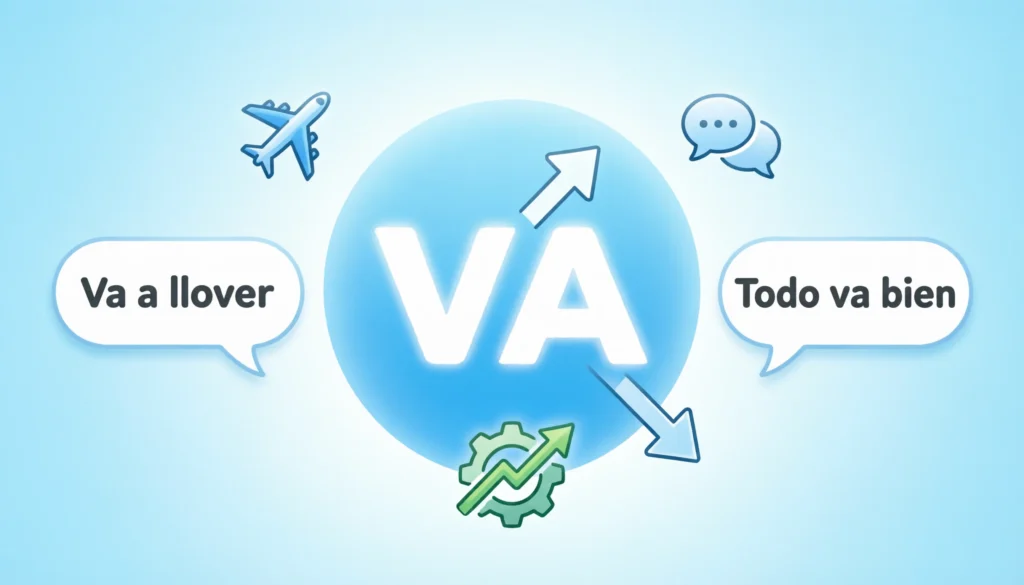
“Va” in Spanish most commonly means “goes” or “is going.” It is the third-person singular form of the verb ir (to go). Depending on the context, “va” can translate to “goes,” “is going,” “works,” “fits,” or “is doing” something. It’s often used to describe movement, future plans, or how something functions.
For example:
Ella va a la tienda. → She goes to the store.
Esto va bien. → This is going well.
Understanding how “va” works in Spanish can help you recognize everyday conversations, especially because it appears frequently in spoken language.
Understanding What “Va” Means in Spanish
If you’ve ever heard Spanish speakers say “va”, you might wonder exactly what it means. The word is small but powerful because it comes from one of the most common verbs in Spanish: ir (to go).
Because Spanish verbs change depending on who is performing the action, the verb ir has several forms. One of those forms is “va.”
In simple terms:
- Va = he/she/it goes
- Va = he/she/it is going
However, the meaning can change slightly depending on context, tone, and sentence structure.
Origin of “Va” in Spanish
The word “va” comes from the verb ir, which means “to go.”
Conjugation of “Ir” (Present Tense)
| Subject | Spanish | English Meaning |
|---|---|---|
| Yo | Voy | I go |
| Tú | Vas | You go |
| Él/Ella/Usted | Va | He/She goes |
| Nosotros | Vamos | We go |
| Vosotros | Vais | You all go |
| Ellos/Ellas | Van | They go |
As you can see, “va” is used with third-person subjects, such as:
- él (he)
- ella (she)
- usted (formal you)
Example:
- Ella va al trabajo.
→ She goes to work.
The verb ir comes from Latin “ire,” meaning “to go.” Over centuries, Spanish kept the root meaning while evolving its modern conjugations.
Why “Va” Is So Common in Spanish
“Va” is extremely common because the verb ir is used in many everyday situations, such as:
- Talking about movement
- Describing future plans
- Explaining how something works
- Giving informal approval
For example, Spanish speakers frequently use “ir + a + verb” to talk about the future.
Example:
- Ella va a estudiar.
→ She is going to study.
This structure is similar to “going to” in English.
Main Meanings of “Va” in Spanish
Although the core meaning is “goes,” the word va can have several interpretations depending on context.
1. Physical Movement
The most direct meaning relates to going somewhere.
Example:
- El tren va a Madrid.
→ The train goes to Madrid.
Tone: Neutral 🚆
2. Something Is Happening or Progressing
“Va” can describe how something is going or progressing.
Example:
- Todo va bien.
→ Everything is going well.
Tone: Positive 🙂
3. Agreement or Approval
In casual Spanish, “va” can mean “okay,” “sure,” or “that works.”
Example:
- ¿Nos vemos mañana?
- Va.
Translation:
- “Shall we meet tomorrow?”
- “Okay.”
Tone: Friendly 👍
4. How Something Functions
Sometimes “va” describes how something works.
Example:
- Este teléfono va rápido.
→ This phone works fast.
Tone: Neutral 📱
5. Describing Fit or Placement
“Va” can also refer to how something fits or belongs somewhere.
Example:
- Este cuadro va aquí.
→ This picture goes here.
Tone: Neutral 🖼️
Real-Life Examples of “Va” in Spanish
Here are some everyday sentences that include “va.”
| Spanish Sentence | English Meaning | Tone |
|---|---|---|
| Ella va al mercado. | She goes to the market. | Neutral |
| Todo va perfecto. | Everything is going perfectly. | Positive |
| ¿Cómo va el trabajo? | How is work going? | Friendly |
| Va a llover hoy. | It is going to rain today. | Neutral |
| Va, está bien. | Okay, that’s fine. | Casual |
These examples show how context determines the exact meaning.
“Va” in the Future Construction (Ir + A + Verb)
One of the most important uses of “va” appears in the near-future structure.
Structure
Subject + va + a + verb
Example:
- Ella va a viajar mañana.
Translation:
- She is going to travel tomorrow.
This construction is extremely common because it’s simpler than the formal future tense.
More Examples
- Va a empezar la película.
→ The movie is going to start. - Va a estudiar medicina.
→ He/She is going to study medicine.
Tone and Context: What “Va” Can Sound Like
Depending on tone, “va” can sound different.
Friendly Tone 🙂
- Va, nos vemos luego.
→ “Okay, see you later.”
Neutral Tone
- El autobús va al centro.
→ “The bus goes downtown.”
Slightly Dismissive Tone 😐
- Va, lo que tú digas.
→ “Fine, whatever you say.”
Tone often depends on voice, punctuation, or context.
Comparison With Related Spanish Words
Because “va” is short, learners sometimes confuse it with similar words.
| Word | Meaning | Example |
|---|---|---|
| Va | Goes / is going | Ella va al parque. |
| Vas | You go | Tú vas al cine. |
| Van | They go | Ellos van a casa. |
| Vamos | We go / let’s go | Vamos a comer. |
Quick Tip
If you see “va,” it usually refers to he, she, it, or usted.
Alternate Meanings of “Va”
Although “va” usually comes from ir, it can have other minor uses.
1. Interjection Meaning “Okay”
Used informally in conversation.
Example:
- Va, está bien.
→ “Okay, that’s fine.”
2. In Idiomatic Expressions
Example:
- Así va la vida.
→ “That’s how life goes.”
3. In Informal Speech
Sometimes used as a short response of agreement.
Example:
- ¿Listo?
- Va.
Translation:
- “Ready?”
- “Okay.”
Polite or Professional Alternatives
In formal conversations, instead of saying just “va,” Spanish speakers may use:
| Alternative | Meaning | When to Use |
|---|---|---|
| De acuerdo | Agreed | Formal settings |
| Está bien | That’s fine | Neutral tone |
| Perfecto | Perfect | Friendly |
| Claro | Of course | Polite response |
Example:
- Instead of “Va.”
You could say “De acuerdo.”
Practical Tips for Using “Va”
Here are some helpful tips for Spanish learners:
1. Pay Attention to Context
The meaning changes depending on the sentence.
2. Watch the Subject
“Va” usually refers to he/she/it/usted.
3. Recognize Future Structures
If you see “va a + verb,” it usually means “going to.”
Example:
- Va a empezar. → “It’s going to start.”
4. Listen for Tone
In conversation, tone changes meaning slightly.
FAQs
1. What does “va” mean in Spanish?
“Va” most commonly means “goes” or “is going.” It is the third-person singular form of the Spanish verb ir, which means “to go.” Depending on context, it can also mean “works,” “fits,” or “is going well.”
2. Is “va” a verb in Spanish?
Yes. “Va” is a conjugated form of the verb ir (to go). It is used with él (he), ella (she), or usted (formal you).
3. What does “va a” mean in Spanish?
“Va a” means “is going to.” It is part of a common Spanish structure used to talk about future actions.
Example: Ella va a estudiar. → “She is going to study.”
4. Can “va” mean “okay” in Spanish?
Yes. In informal conversation, “va” can be used as a short response meaning “okay,” “sure,” or “that works.”
5. What does “todo va bien” mean?
“Todo va bien” means “everything is going well.” It’s a common phrase used when things are progressing positively.
6. What is the difference between “va” and “vas”?
The difference is the subject of the verb.
- Va → he/she/it goes
- Vas → you go (informal singular)
7. Is “va” formal or informal?
The verb form itself is neutral and grammatically standard, but when used alone to mean “okay,” it is usually informal or conversational.
8. Why do Spanish speakers use “va” so often?
Spanish speakers use “va” frequently because it comes from the verb ir (to go), which is one of the most commonly used verbs in everyday Spanish conversations.
Conclusion
Although it’s only two letters long, “va” is one of the most useful words in Spanish. It comes from the verb ir (to go) and usually means “goes” or “is going.” However, depending on context, it can also describe progress, agreement, function, or placement.
For Spanish learners, recognizing how context shapes meaning is the best way to master the word. Once you start listening to real conversations, you’ll notice “va” everywhere in everyday Spanish.
Discover More Related Articles:
- Understanding FIP in Baseball: Definition, Formula, and Uses (2026)
- TW in Jewelry Meaning: What It Really Stands For (2026)

James Anderson is an experienced content writer and language researcher who focuses on explaining word meanings, definitions, slang terms, and modern expressions. He writes for WordNexy.com, where his articles are designed to provide accurate meanings, practical usage examples, and easy-to-understand explanations for readers worldwide.