
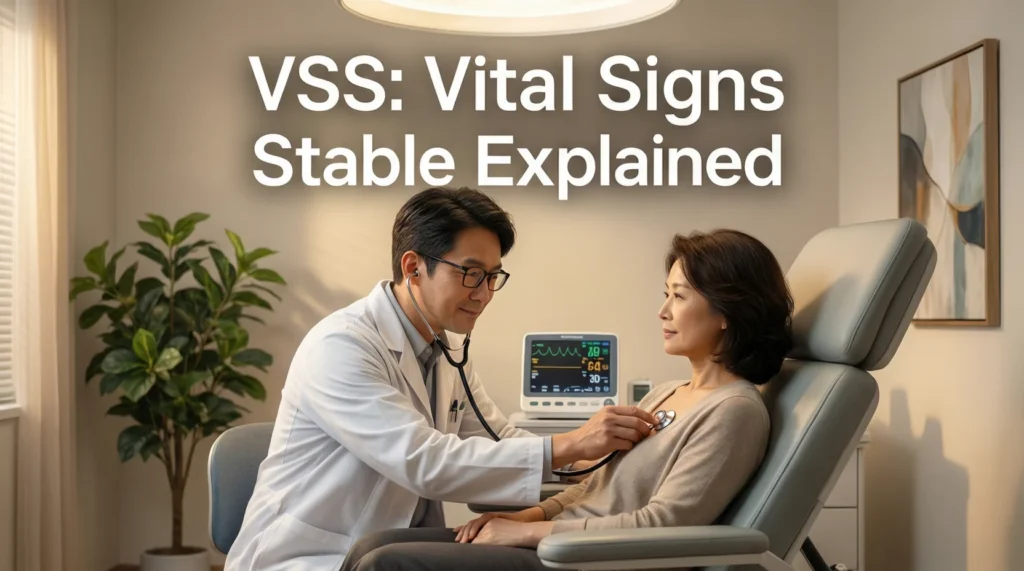
In medical terms, VSS stands for “Vital Signs Stable.” It indicates that a patient’s key health indicators such as heart rate, blood pressure, respiratory rate, and temperature are within normal limits and showing no signs of acute distress.
Simply put, when a clinician writes “VSS” in a chart, it’s a shorthand way of saying, “The patient’s vital signs are stable and currently not a cause for concern.”
Origin and Popularity of VSS
The abbreviation VSS comes from traditional medical charting practices, which prioritize brevity without losing clarity. Medical professionals, especially nurses and doctors, need to communicate patient status quickly in fast-paced environments like hospitals, emergency rooms, and clinics. Using shorthand like VSS allows them to document efficiently while keeping other staff informed.
Over time, VSS has become a standard term in electronic health records (EHRs) and patient charts worldwide. It’s widely recognized among healthcare providers and often appears in progress notes, patient assessment forms, and clinical documentation.
Real-World Usage of VSS
VSS is primarily used in patient charts, nursing notes, and medical reports. Here’s a typical example in context:
“Patient admitted for mild dehydration. VSS throughout the morning. No complaints of dizziness or pain.”
This tells any clinician reviewing the record that the patient’s vital signs are currently normal, making it unnecessary to take immediate action unless new symptoms develop.
Common Situations Where VSS Appears:
- Post-surgery monitoring: Ensures that the patient’s vital signs are stable after anesthesia.
- Routine checkups: Notes that everything is normal without listing each vital sign individually.
- Emergency triage: Quickly communicates patient stability to other healthcare professionals.
Understanding Vital Signs
To fully appreciate what VSS means, it’s helpful to know what vital signs are:
| Vital Sign | Normal Range (Adults) | Purpose |
|---|---|---|
| Heart Rate | 60–100 bpm | Measures heart function and rhythm |
| Blood Pressure | 90/60–120/80 mmHg | Evaluates circulation and cardiac health |
| Respiratory Rate | 12–20 breaths/min | Assesses lung function |
| Temperature | 36.1–37.2°C (97–99°F) | Detects fever or hypothermia |
| Oxygen Saturation | 95–100% | Monitors oxygen delivery to tissues |
When a patient is VSS, all these parameters are within acceptable limits.
Examples of VSS in Medical Notes
Here’s how VSS might appear in real-world medical documentation:
- Neutral tone (typical clinical documentation): “Patient resting post-injection. VSS. No adverse reactions noted.”
- Friendly tone (patient-friendly summary for rounds): “All checked! VSS 😊. Heart rate and blood pressure look perfect.”
- Negative or dismissive context (used in busy ER notes): “Patient anxious but VSS. No acute intervention needed.”
Comparison with Related Medical Abbreviations
Medical documentation is full of abbreviations, so it’s helpful to compare VSS with similar terms:
| Abbreviation | Meaning | Difference from VSS |
|---|---|---|
| VS | Vital Signs | VS just indicates the measurement itself; VSS confirms stability |
| WNL | Within Normal Limits | Broader than VSS; can refer to lab values or physical exam findings |
| NAD | No Acute Distress | Focuses on patient symptoms rather than objective vital signs |
| RRR | Regular Rate & Rhythm | Specific to heart rate; doesn’t address BP, temperature, or respiration |
Tip: While VSS is specific to stability, other terms like WNL or NAD may also indicate a “normal” state but in different contexts.
Alternate Meanings of VSS
Outside of medicine, VSS can mean other things, but these are rarely used in a healthcare setting:
- Vehicle Speed Sensor – in automotive contexts
- Video Surveillance System – in security industries
- Virtual Storage System – in IT and computing
In healthcare documentation, however, VSS almost always refers to “Vital Signs Stable.”
Polite or Professional Alternatives
If you want to communicate the same information without abbreviations (for clarity in patient-facing documents), you can use:
- “The patient’s vital signs are stable.”
- “No abnormalities noted in vital signs.”
- “Patient is currently hemodynamically stable.” (more formal, often in physician notes)
FAQs
1. What does VSS mean on a hospital chart?
VSS means “Vital Signs Stable,” indicating that the patient’s heart rate, blood pressure, temperature, and respiratory rate are all within normal limits.
2. Is VSS the same as WNL?
Not exactly. WNL (“Within Normal Limits”) is broader and can refer to lab tests, exams, or other assessments, whereas VSS specifically refers to vital signs.
3. Does VSS mean the patient is healthy?
Not necessarily. VSS only indicates that vital signs are currently stable; it doesn’t rule out underlying conditions or ongoing treatment needs.
4. Can VSS change quickly?
Yes. Vital signs can fluctuate due to illness, stress, or medication. Continuous monitoring may be required in certain patients.
5. Who uses the term VSS?
Doctors, nurses, paramedics, and other healthcare professionals frequently use VSS in clinical documentation and handoffs.
6. Is VSS used for all patients?
Yes, VSS can be applied to patients of any age, though the normal ranges for vital signs may vary depending on age or health status.
7. How is VSS documented in EHRs?
It is often entered as shorthand in progress notes, nursing assessments, or physician rounds, sometimes alongside actual readings for reference.
8. Can patients ask what VSS means?
Absolutely! Medical staff can explain that it simply indicates their vital signs are stable and not currently concerning.
Practical Tips When You See VSS
- Understand the context: VSS is positive but not a comprehensive health indicator.
- Check for trends: Stable vital signs are good, but doctors also review trends over time.
- Ask questions: If you’re a patient or caregiver, ask staff what VSS means for your overall condition.
- Use it in shorthand wisely: Healthcare professionals rely on concise notes, but clarity is key when communicating with patients.
Conclusion
VSS, meaning Vital Signs Stable, is a cornerstone shorthand in medical documentation. It provides a quick, reliable way for healthcare professionals to convey a patient’s current stability.
While it indicates that immediate intervention may not be needed, it is not a replacement for comprehensive health evaluation. Understanding VSS helps patients, caregivers, and professionals navigate medical records confidently.
Discover More Related Articles:

Amanda Lewis is a professional content writer and word-meaning researcher who specializes in explaining definitions, slang, abbreviations, and modern language terms. She writes for WordNexy.com, where she creates clear, accurate, and reader-friendly articles to help users understand word meanings and proper usage. Her work is especially useful for students, writers, and online readers seeking quick and reliable explanations.

