Definition:
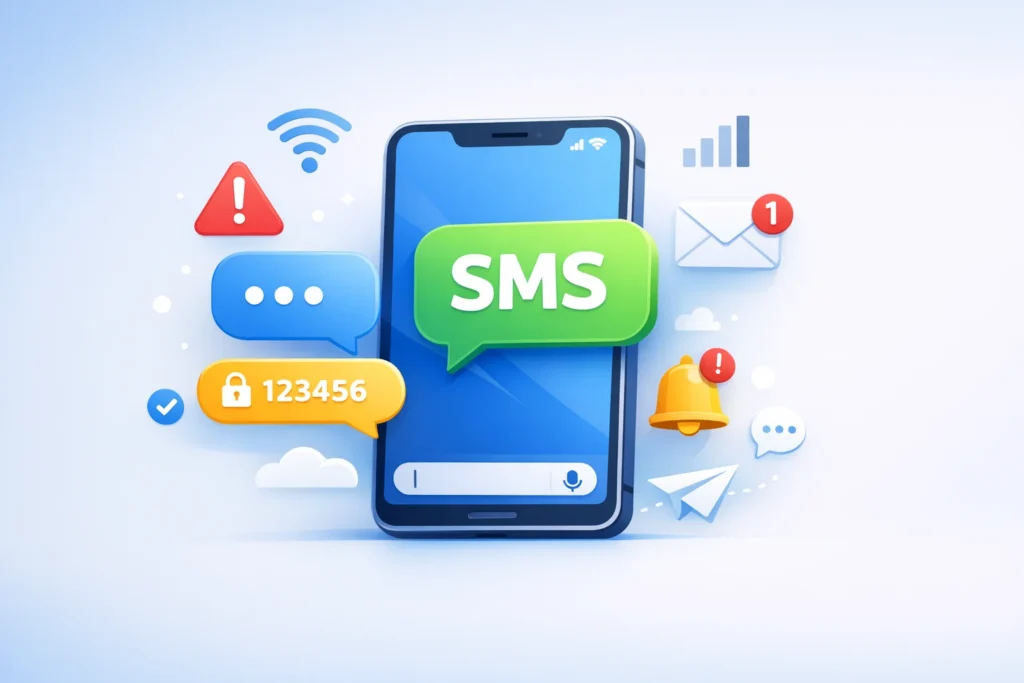
SMS stands for “Short Message Service.” It is a text messaging service that allows users to send short text messages (typically up to 160 characters) between mobile devices over cellular networks.
Even in the age of WhatsApp, Messenger, and social media DMs, SMS remains one of the most widely used communication methods worldwide. Whether you’re receiving a bank alert, a verification code, or a simple “I’m on my way” message, chances are you’re using SMS without even thinking about it.
But what exactly does SMS mean, how does it work, and why is it still relevant today? This guide breaks it all down in a simple, engaging way—plus examples, comparisons, and practical tips you can actually use.
What Does SMS Mean?
SMS (Short Message Service) is a standard communication protocol used by mobile phones to send and receive short text messages over cellular networks.
Key Points:
- Message limit: 160 characters (standard)
- Works without internet (uses cellular signal)
- Supported on all mobile phones (smartphones + basic phones)
- Often used for alerts, notifications, and personal texting
The Origin of SMS
SMS didn’t start as a casual texting tool—it actually began as a technical feature.
A Brief History:
- 1980s: SMS concept developed as part of GSM (Global System for Mobile Communications)
- 1992: First SMS ever sent: “Merry Christmas”
- Late 1990s – early 2000s: Texting becomes popular worldwide
- Today: Billions of SMS messages are still sent daily
Why It Became Popular:
- No internet required
- Cheap and widely accessible
- Simple and fast communication
- Works on all mobile devices
How SMS Works
SMS messages are sent through your mobile network instead of the internet.
Basic Process:
- You type a message on your phone
- It is sent to a Short Message Service Center (SMSC)
- The SMSC forwards it to the recipient’s phone
- The message is delivered instantly (or stored if the phone is off)
Real-World Usage of SMS
SMS is used in both personal and professional communication.
Common Uses:
- Personal texting (“Where are you?”)
- OTP codes (One-Time Passwords)
- Banking alerts
- Appointment reminders
- Marketing messages
- Emergency alerts
Why Businesses Still Use SMS:
- High open rate (over 90%)
- Instant delivery
- No need for apps or internet
Examples of SMS in Different Contexts
Here’s how SMS looks in everyday situations:
📱 Friendly Tone
- “Hey! I’ll be there in 10 mins 😊”
- “Don’t forget the meeting today!”
📱 Neutral Tone
- “Your package has been delivered.”
- “Your OTP code is 458921.”
📱 Urgent / Alert Tone
- “Your account was accessed from a new device.”
- “Emergency alert: Please stay indoors.”
📱 Slightly Negative / Dismissive Tone
- “Text me later, I’m busy.”
- “Stop sending these messages.”
Example Table: SMS Use Cases
| Scenario | Example Message | Tone |
|---|---|---|
| Personal Chat | “Call me when you’re free.” | Friendly |
| Banking Alert | “Rs. 5,000 withdrawn from your account” | Neutral |
| OTP Verification | “Your code is 123456” | Informative |
| Marketing Message | “Get 20% off today only!” | Promotional |
| Emergency Alert | “Flood warning in your area” | Urgent |
SMS vs Other Messaging Terms
Understanding SMS becomes easier when you compare it with similar terms.
SMS vs MMS vs Chat Apps
| Feature | SMS | MMS | Chat Apps (WhatsApp, etc.) |
|---|---|---|---|
| Full Form | Short Message Service | Multimedia Messaging Service | Internet Messaging Apps |
| Content | Text only | Images, videos, audio | All media types |
| Internet Needed | ❌ No | ❌ No (uses network) | ✅ Yes |
| Cost | Usually charged per message | Higher than SMS | Usually free (data only) |
| Availability | All phones | Most phones | Smartphones only |
Difference SMS vs Texting: Are They the Same?
Not exactly.
- SMS = The technology (Short Message Service)
- Texting = The action of sending messages
👉 In everyday language, people use them interchangeably.
Alternate Meanings of SMS
While “Short Message Service” is the most common meaning, SMS can have other meanings depending on context:
Other Possible Meanings:
- School Management System (education)
- Safety Management System (aviation, workplace safety)
- Subscriber Management System (telecom)
- Systems Management Server (IT)
👉 Always look at the context to understand the correct meaning.
Tone & Interpretation in SMS
Unlike face-to-face conversation, SMS lacks tone and body language. This can lead to misunderstandings.
Examples:
- “Okay.” → Neutral or slightly cold
- “Okay 😊” → Friendly
- “OK.” → Can feel abrupt or annoyed
Tips:
- Use emojis to soften tone 🙂
- Avoid very short replies if clarity matters
- Be mindful of punctuation
Advantages of SMS
Why People Still Use SMS:
- Works without internet
- Extremely reliable
- High delivery rate
- Universal compatibility
- Quick communication
Disadvantages of SMS
Limitations:
- Character limit (160)
- No rich media (unless MMS)
- Can feel outdated compared to apps
- May incur charges
Polite & Professional Alternatives to SMS
In some situations, SMS may not be the best communication method.
Better Alternatives:
- Email – For formal communication
- Messaging apps – For detailed chats
- Phone calls – For urgent or complex matters
Example:
Instead of SMS:
- “Send report now”
Use:
- “Hi, could you please send the report when you have a moment?”
FAQs
1. What does SMS mean in texting?
SMS means Short Message Service, a system used to send text messages between mobile devices.
2. Is SMS the same as a text message?
Yes, SMS is the technical term for a standard text message.
3. Does SMS require internet?
No, SMS works through cellular networks and does not require internet.
4. What is the SMS character limit?
A standard SMS can contain up to 160 characters.
5. What is the difference between SMS and MMS?
SMS is text-only, while MMS allows multimedia like images and videos.
6. Why do businesses use SMS?
Because it has high open rates, fast delivery, and works without apps.
7. Is SMS still used today?
Yes, SMS is still widely used for alerts, verification codes, and communication.
8. Can SMS be sent internationally?
Yes, SMS can be sent globally, though charges may apply depending on your carrier.
Conclusion:
SMS may seem simple, but it’s one of the most powerful communication tools ever created. It has stood the test of time because of its reliability, accessibility, and ease of use.
Even with modern messaging apps, SMS remains essential for everyday use especially for OTP codes, banking alerts, notifications, and quick personal communication. Its character limit, instant delivery, and compatibility with all phones keep it relevant even today.
While SMS is less feature-rich than apps like WhatsApp or Messenger, it still plays a crucial role in secure, direct, and accessible communication worldwide. Understanding SMS helps you better recognize how your phone communicates behind the scenes and why it continues to be used globally.
Discover More Related Articles:

Amanda Lewis is a professional content writer and word-meaning researcher who specializes in explaining definitions, slang, abbreviations, and modern language terms. She writes for WordNexy.com, where she creates clear, accurate, and reader-friendly articles to help users understand word meanings and proper usage. Her work is especially useful for students, writers, and online readers seeking quick and reliable explanations.