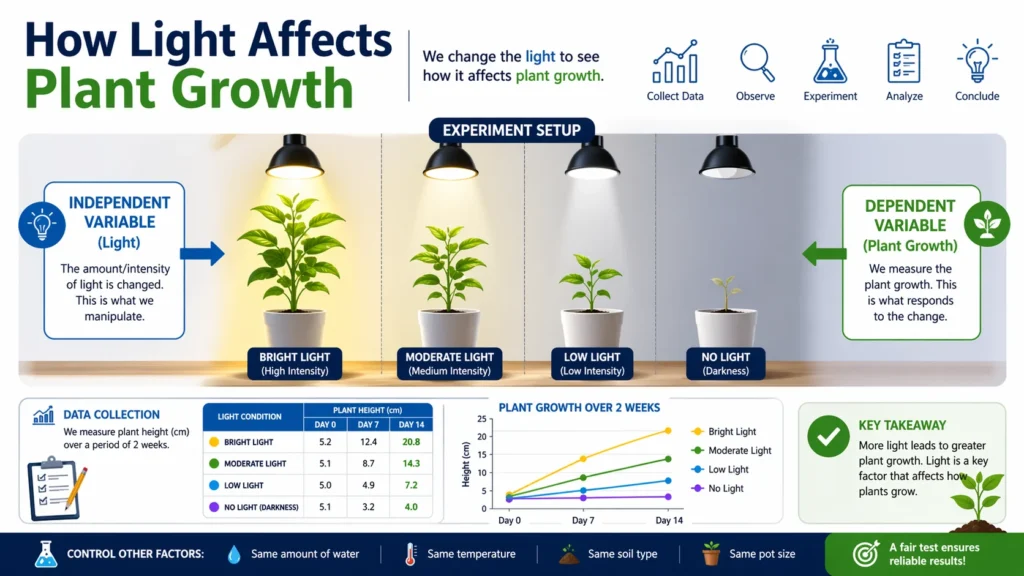
Definition
A dependent variable in science is the factor that is measured or observed in an experiment. It changes in response to the independent variable, which is the factor that the researcher manipulates.
Imagine you’re testing whether sunlight helps plants grow faster. You change how much light the plants receive but what are you actually watching to see the result? That’s where the dependent variable comes in.
In science, experiments aren’t just about trying things randomly they’re about understanding cause and effect. The dependent variable plays a key role because it represents the outcome of your experiment. Whether you’re a student, researcher, or just curious about how science works, mastering this concept helps you:
- Design better experiments
- Interpret results accurately
- Avoid common scientific mistakes
Let’s break it down in a simple, clear, and practical way.
What Is a Dependent Variable?
A dependent variable is the result you measure in an experiment. It “depends” on changes made to another variable the independent variable.
In Plain English:
- Independent variable = what you change
- Dependent variable = what you measure
👉 Think of it like this:
“If I change this (independent variable), what happens to that (dependent variable)?”
Origin and Meaning of the Term
The concept of dependent variables comes from the scientific method, which has been used for centuries to test hypotheses and understand the natural world.
- The term “dependent” means something that relies on something else
- In experiments, the outcome depends on the conditions you set
Why It Became Popular
The idea gained widespread use in fields like:
- Physics
- Biology
- Psychology
- Social sciences
Today, it’s a core concept taught in schools worldwide, from basic science classes to advanced research.
Real-World Usage of Dependent Variables
Dependent variables aren’t just for labs they’re used in everyday situations too.
Examples in Daily Life:
- Fitness:
- Independent variable: Exercise routine
- Dependent variable: Weight loss
- Education:
- Independent variable: Study time
- Dependent variable: Test scores
- Marketing:
- Independent variable: Advertising budget
- Dependent variable: Sales revenue
👉 In every case, the dependent variable shows the effect of a change.
How to Identify a Dependent Variable
Here are some easy ways to spot it:
Ask Yourself:
- What am I measuring?
- What is the result or outcome?
- What changes because of something else?
Quick Tip:
The dependent variable is often plotted on the Y-axis in graphs.
Labeled Example Table
| Experiment Scenario | Independent Variable | Dependent Variable |
|---|---|---|
| Plant growth test | Amount of sunlight | Height of plant |
| Baking cookies | Oven temperature | Cookie texture |
| Studying habits | Hours of study | Exam score |
| Medicine effectiveness | Dosage of drug | Patient recovery rate |
| Exercise experiment | Time spent exercising | Calories burned |
Step-by-Step Example
Experiment: Does Water Affect Plant Growth?
- Independent Variable: Amount of water
- Dependent Variable: Plant height
What Happens?
You give different plants different amounts of water and measure how tall they grow.
Tone Example:
- Friendly: “Wow, the plant with more water grew taller 🌱!”
- Neutral: “The results show increased growth with more water.”
- Slightly dismissive: “Of course it grew more it had more water.”
Dependent Variable vs Independent Variable
| Feature | Dependent Variable | Independent Variable |
|---|---|---|
| Role | Outcome/result | Cause/input |
| Controlled by researcher | No | Yes |
| Measured or changed | Measured | Changed |
| Graph position | Y-axis | X-axis |
Easy Memory Trick:
👉 Independent = I change it
👉 Dependent = It depends on that change
Dependent Variable vs Controlled Variables
Another important comparison:
- Dependent Variable: What you measure
- Independent Variable: What you change
- Controlled Variables: What you keep the same
Example:
In a plant experiment:
- Independent: Water amount
- Dependent: Growth
- Controlled: Soil type, sunlight, pot size
Usage in Different Scientific Fields
1. Biology
- Measuring cell growth, enzyme activity, or plant height
2. Chemistry
- Observing reaction speed or color change
3. Physics
- Measuring motion, force, or energy output
4. Psychology
- Tracking behavior, reaction time, or mood changes
5. Social Sciences
- Analyzing income, happiness levels, or survey responses
Common Mistakes to Avoid
Even simple concepts can trip people up. Watch out for these:
❌ Confusing variables
Many people mix up independent and dependent variables.
❌ Measuring the wrong thing
Make sure your dependent variable actually reflects the outcome.
❌ Not controlling other factors
If other variables change, your results may become unreliable.
Tips for Using Dependent Variables Correctly
- Always define your variables clearly before starting
- Use measurable and specific outcomes
- Keep experiments simple and controlled
- Record results consistently
Alternate Meanings of “Dependent Variable”
While mainly used in science, the term can appear in:
- Mathematics: A variable whose value depends on another variable
- Statistics: The outcome being analyzed
In most contexts, the meaning stays consistent:
👉 It’s the result influenced by another factor.
Polite or Professional Alternatives
Depending on context, you might use:
- Outcome variable
- Response variable
- Measured variable
- Output variable
These are often used in academic or professional writing.
FAQs
1. What is a dependent variable in simple terms?
A dependent variable is the result you measure in an experiment. It changes based on another variable.
2. How do you identify a dependent variable?
Look for what is being measured or observed as the outcome.
3. What is an example of a dependent variable?
Plant height in a sunlight experiment is a dependent variable.
4. Is the dependent variable always on the Y-axis?
Yes, in most graphs, the dependent variable is plotted on the Y-axis.
5. Can there be more than one dependent variable?
Yes, some experiments measure multiple outcomes.
6. Why is it called “dependent”?
Because its value depends on changes made to another variable.
7. What is the difference between dependent and independent variables?
The independent variable is changed, while the dependent variable is measured.
8. Is a dependent variable controlled?
No, it is observed not controlled directly.
Conclusion:
Understanding the dependent variable is essential for anyone working with experiments or data. It represents the outcome, the result, and ultimately the answer to your scientific question.
To use it effectively:
- Focus on what you’re measuring
- Keep your experiment controlled
- Clearly separate independent and dependent variables
Once you grasp this concept, you’ll find it much easier to design experiments, analyze data, and understand scientific results.
Discover More Related Articles:

Amanda Lewis is a professional content writer and word-meaning researcher who specializes in explaining definitions, slang, abbreviations, and modern language terms. She writes for WordNexy.com, where she creates clear, accurate, and reader-friendly articles to help users understand word meanings and proper usage. Her work is especially useful for students, writers, and online readers seeking quick and reliable explanations.