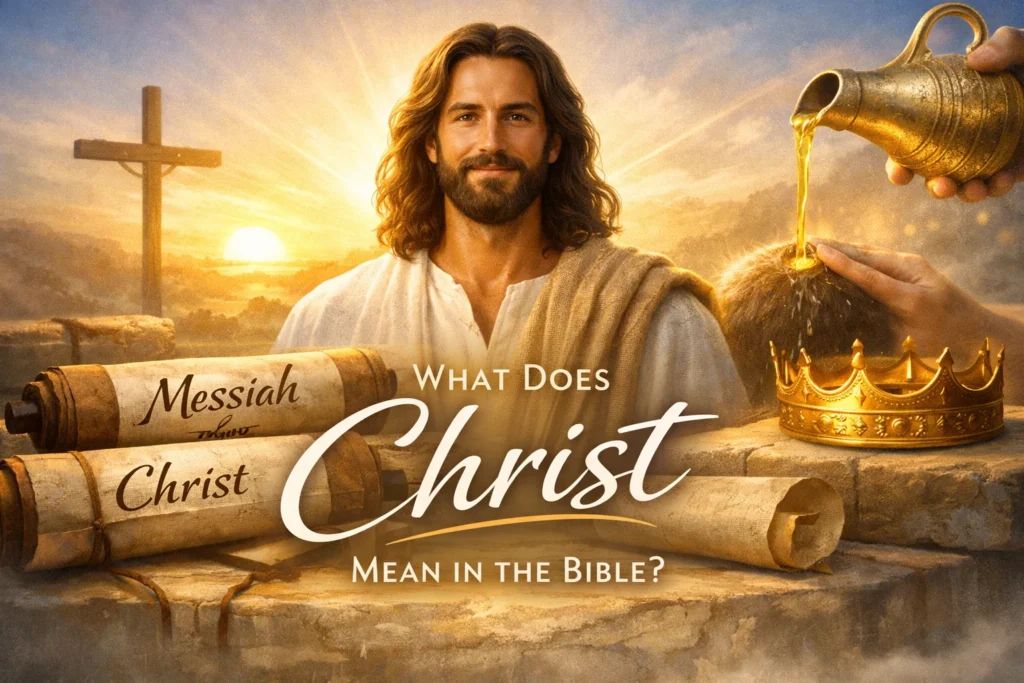
Definition:
“Christ” in the Bible means “the Anointed One.” It comes from the Greek word Christos, which translates the Hebrew term Messiah (Mashiach) a title given to someone chosen and empowered by God for a special purpose, especially Jesus as the Savior and King.
If you’ve ever read the Bible or heard the name Jesus Christ, you might assume “Christ” is simply His last name. But in reality, it’s much deeper and much more powerful.
“Christ” is a title, not a surname. It carries centuries of prophecy, hope, and meaning rooted in the Bible. Understanding what “Christ” means opens the door to understanding the identity, mission, and significance of Jesus in both the Old and New Testaments.
Whether you’re studying Scripture, exploring faith, or simply curious, this guide will walk you through everything you need to know in a clear, friendly, and practical way.
What Does “Christ” Mean in the Bible?
At its core, “Christ” means “the Anointed One.”
In biblical times, anointing someone with oil symbolized that they were chosen by God for a special role. This could include:
- Kings (like David)
- Priests (spiritual leaders)
- Prophets (God’s messengers)
When the Bible calls Jesus “Christ,” it declares that He is God’s chosen King, Priest, and Savior.
Origin of the Word “Christ”
The word “Christ” has a rich linguistic and historical background:
| Language | Word | Meaning |
|---|---|---|
| Hebrew | Mashiach (Messiah) | Anointed One |
| Greek | Christos | Anointed One |
| English | Christ | Title for Jesus |
Key Points:
- The Old Testament (written mostly in Hebrew) uses Messiah.
- The New Testament (written in Greek) uses Christos.
- Both words mean the same thing: God’s chosen deliverer.
“Christ” in the Old Testament
Before Jesus was born, the Bible foretold the coming of a Messiah a Savior who would:
- Rescue God’s people
- Establish a righteous kingdom
- Bring peace and justice
Examples of Messianic Prophecies:
- A king from David’s line
- A suffering servant who bears sins
- A ruler who brings everlasting peace
These expectations built anticipation over hundreds of years.
“Christ” in the New Testament
In the New Testament, Jesus is revealed as the Christ the fulfillment of all those prophecies.
What This Means:
- Jesus is not just a teacher He is the promised Savior
- His life, death, and resurrection confirm His role
- The title “Christ” affirms His divine mission
👉 That’s why the Bible often says “Jesus Christ” or “Christ Jesus”both emphasize His identity as the Messiah.
Real-World Usage of “Christ”
Today, the word “Christ” appears in different contexts:
1. Religious Context (Correct Use)
- “Jesus Christ is the Savior.”
- “Christ died for our sins.”
👉 Tone: Respectful, faith-based
2. Casual or Cultural Use
- “Oh my Christ!” (used as an exclamation)
👉 Tone:
- Can be neutral in some cultures
- Often considered disrespectful in religious contexts ⚠️
3. Academic or Historical Discussion
- “The term Christ originates from Greek.”
👉 Tone: Neutral, educational
Example Table: How “Christ” Is Used
| Sentence | Context | Tone |
|---|---|---|
| “Jesus Christ is Lord.” | Religious | Respectful |
| “Christ fulfilled prophecy.” | Biblical study | Neutral |
| “Oh Christ!” | Casual speech | Informal / Possibly offensive |
| “The word Christ means anointed.” | Educational | Neutral |
Is “Christ” a Name or a Title?
This is a very common question.
👉 Answer: It’s a title, not a last name.
- Jesus = His given name
- Christ = His role and identity
Think of it like:
- “King David” → David is the name, King is the title
- “Jesus Christ” → Jesus is the name, Christ is the title
Comparison with Related Terms
| Term | Meaning | Difference |
|---|---|---|
| Messiah | Hebrew term for “Anointed One” | Used in Old Testament |
| Christ | Greek equivalent of Messiah | Used in New Testament |
| Lord | Title of authority and divinity | Broader than Christ |
| Savior | One who rescues | Describes Christ’s role |
👉 Simple takeaway:
- Messiah = Christ (same meaning, different languages)
Alternate Meanings or Misunderstandings
While “Christ” has a clear biblical meaning, some misunderstandings include:
- ❌ Thinking it’s Jesus’ last name
- ❌ Using it casually without knowing its significance
- ❌ Assuming it refers to multiple “christs” in the same sense
Important Note:
In Christian belief, Jesus is the Christ—not just one of many.
Polite or Professional Alternatives
If you want to speak respectfully or professionally:
- Use “Jesus” or “Jesus Christ” in religious discussions
- Use “the Messiah” in academic or interfaith contexts
- Avoid using “Christ” as a casual exclamation
Why “Christ” Is Central to the Bible
Understanding “Christ” helps you understand:
- The entire storyline of the Bible
- God’s plan for humanity
- The identity of Jesus
In short:
👉 Without understanding “Christ,” you miss the core message of the Bible.
FAQs:
- What does “Christ” literally mean?
It means “Anointed One”, referring to someone chosen by God for a special purpose. - Is Christ Jesus’ last name?
No. Christ is a title, not a surname. - What is the difference between Christ and Messiah?
They mean the same thing. Messiah is the Hebrew term, and Christ is the Greek equivalent. - Why is Jesus called Christ?
Because He fulfills the role of God’s promised Savior and Anointed One. - Is “Christ” used in the Old Testament?
Not directly. The Old Testament uses the term Messiah, which Christ translates in Greek. - Can “Christ” refer to anyone else?
In the Bible, it refers uniquely to Jesus as the ultimate Messiah. - Why do people say “Jesus Christ” together?
To combine His personal name (Jesus) with His divine title (Christ). - Is it wrong to use “Christ” casually?
It depends on context, but many consider it disrespectful in casual or exclamatory use.
Conclusion:
“Christ” is a profound title meaning “the Anointed One”, identifying Jesus as God’s chosen Savior, King, and Priest. Rooted in the Hebrew Messiah and expressed in Greek as Christos, this term bridges Old Testament prophecy with New Testament fulfillment.
In short:
- “Con” = “with”
- Used for people, things, and emotions
- Works in all tones (friendly, neutral, formal)
- Opposite is “sin” (without)
Once you start using “con” confidently, your Spanish will instantly sound more natural and fluent.
Discover More Related Articles:
- OEM Mean in Car Parts: Here’s Why OEM Could Be the Right Choice in 2026
- Reconciliation Mean in the Bible: A Complete Christian Guide in 2026

James Anderson is an experienced content writer and language researcher who focuses on explaining word meanings, definitions, slang terms, and modern expressions. He writes for WordNexy.com, where his articles are designed to provide accurate meanings, practical usage examples, and easy-to-understand explanations for readers worldwide.