Definition
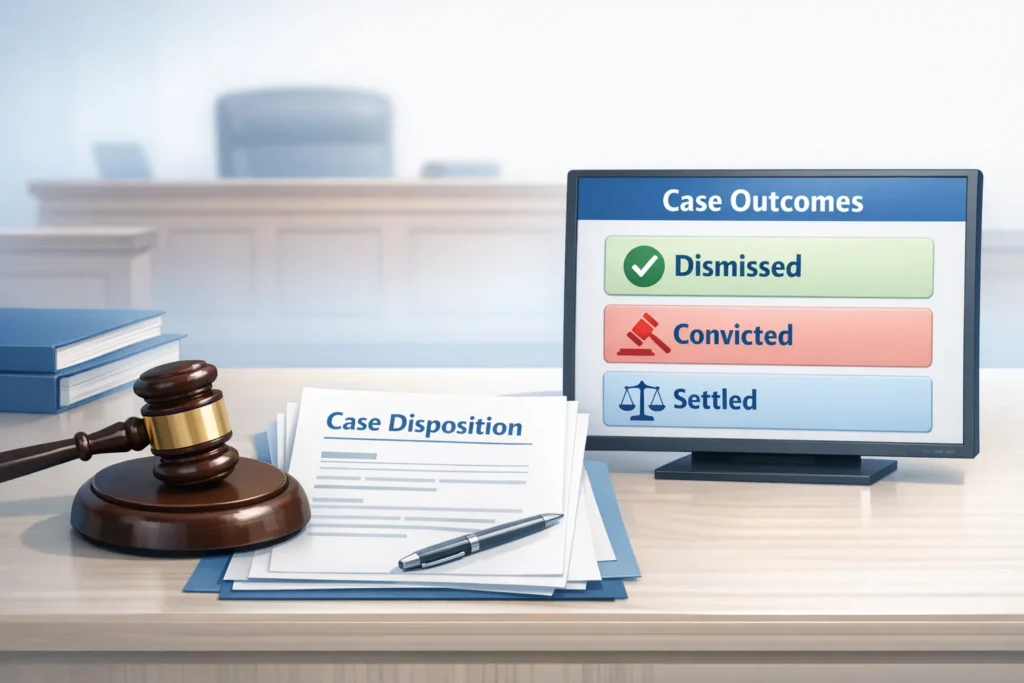
Disposition in a court case refers to the final legal outcome or resolution of a case, showing how the case was decided or closed by the court. It explains whether a case was dismissed, settled, convicted, acquitted, or resolved in another formal way.
If you’ve ever checked a court record and seen the word “disposition”, you might have paused and wondered what does it actually mean?
In simple terms, disposition is the final chapter of a legal case. It tells you how the case ended, not how it started or what happened in the middle. Whether it’s a criminal case, civil dispute, or traffic violation, the disposition is the official result recorded by the court.
Understanding this term is important because it appears in:
- Court documents 🧾
- Background checks 🔍
- Legal reports 📑
- Online case status systems 💻
In this article, we’ll break down everything you need to know about what disposition means in a court case, including examples, types, comparisons, and FAQs.
Origin and Legal Meaning of “Disposition”
The word “disposition” comes from the Latin word disponere, meaning “to arrange or settle.”
In legal language, it evolved to describe:
- How a judge “arranges” the final outcome of a case
- The official resolution after hearings, evidence, and arguments
Today, courts use “disposition” as a standardized term to record:
- Final rulings
- Case closures
- Judgments or settlements
It is widely used in criminal law, civil law, and administrative proceedings across many legal systems, especially in the United States and common law jurisdictions.
What Does Disposition Mean in a Court Case?
In everyday language, disposition means “how the case ended.”
It does NOT describe:
- The full story of the case
- All court hearings
- Evidence details
Instead, it only shows the final result.
Common Court Dispositions Include:
- Dismissed ❌
- Acquitted (not guilty) ✅
- Convicted (guilty) ⚖️
- Settled 💼
- Plea agreement 🤝
- Case closed / no further action
Why Disposition Is Important in Legal Records
Disposition plays a key role in legal transparency and background checks.
It helps:
- Employers verify criminal history
- Lawyers understand case outcomes
- Courts maintain official records
- Individuals track their own legal cases
For example, during a job background check, the disposition will show whether a person was:
- Convicted
- Acquitted
- Or if charges were dismissed
Types of Court Dispositions
Court dispositions vary depending on the case type and outcome.
1. Criminal Case Disposition
Used in criminal trials.
Examples:
- Guilty verdict (conviction)
- Not guilty (acquittal)
- Case dismissed
- Plea bargain accepted
2. Civil Case Disposition
Used in disputes between individuals or organizations.
Examples:
- Settlement agreement
- Judgment for plaintiff
- Judgment for defendant
- Case dismissed without prejudice
3. Administrative Disposition
Used in regulatory or government cases.
Examples:
- License revoked
- Fine imposed
- Case resolved through compliance
Table: Common Dispositions Explained
| Disposition Type | Meaning | Example Outcome |
|---|---|---|
| Dismissed | Case thrown out by court | No trial held |
| Acquitted | Defendant found not guilty | Criminal charges removed |
| Convicted | Defendant found guilty | Jail or fine imposed |
| Settled | Both parties agree to resolve | Compensation paid |
| Plea Bargain | Defendant pleads guilty for lesser charge | Reduced sentence |
| Default Judgment | One party fails to respond | Judgment automatically given |
| Nolle Prosequi | Prosecutor drops charges | Case discontinued |
Real-World Examples of Disposition
Let’s make it simple with everyday-style examples 👇
Example 1: Criminal Case
- Charge: Theft
- Outcome: Evidence insufficient
- Disposition: Acquitted (Not Guilty)
👉 Meaning: The accused is cleared of charges.
Example 2: Civil Case
- Issue: Contract dispute
- Outcome: Parties agree before trial
- Disposition: Settled
👉 Meaning: No trial was needed.
Example 3: Traffic Violation
- Charge: Speeding
- Outcome: Fine paid in court
- Disposition: Guilty / Convicted
👉 Meaning: The driver was legally found responsible.
Disposition vs Verdict vs Judgment
These terms are often confused, but they are not the same.
| Term | Meaning | When It Happens |
|---|---|---|
| Verdict | Jury’s decision (guilty/not guilty) | End of trial |
| Judgment | Judge’s official ruling | After verdict or hearing |
| Disposition | Final case outcome/closure | End of entire case process |
Simple Explanation:
- Verdict = decision
- Judgment = ruling
- Disposition = final result & closure
Alternate Meanings of Disposition
While “disposition” is mostly legal, it can also mean:
1. Personality Trait 😊
- “She has a cheerful disposition.”
👉 Meaning: natural mood or temperament
2. Arrangement or Placement
- “Disposition of assets”
👉 Meaning: distribution or handling of property
But in legal documents, it almost always refers to case outcome.
Professional and Polite Alternatives
If you want to use clearer or simpler legal language, you can say:
- Case outcome
- Final ruling
- Case resolution
- Court decision
- Case closure
- Legal result
These alternatives are often easier for non-lawyers to understand.
How Disposition Appears in Court Records
When you search a case online or in court files, disposition usually appears like:
- “Case Disposed: Convicted”
- “Disposition: Dismissed”
- “Final Disposition: Settled”
- “Case Status: Closed – Acquitted”
It is often found at the bottom of case summaries or status reports.
Why People Search for Disposition Meaning
People usually search this term because they see it in:
- Court websites
- Police records
- Background checks
- Legal paperwork
- Traffic violation reports
It can feel confusing at first, but once you understand it, it simply means:
👉 “How did the case end?”
FAQs:
1. What does disposition mean in simple words?
It means the final outcome or result of a court case.
2. Is disposition the same as conviction?
No. Conviction is one type of disposition, but not all dispositions mean guilty.
3. Can a case be disposed without going to trial?
Yes, cases can be dismissed, settled, or resolved through plea deals.
4. What does “case disposed” mean in court status?
It means the court has finished handling the case and closed it.
5. Is dismissal a disposition?
Yes, dismissal is a common type of legal disposition.
6. Does disposition affect background checks?
Yes, it shows the official result of a case in records.
7. What does “final disposition” mean?
It means the ultimate, official resolution of the case.
8. Can disposition be changed later?
In some cases, yes if there is an appeal or record correction.
Conclusion:
In simple terms, disposition in a court case means the final outcome or resolution of the case it shows how the court officially closed it. Whether a case ends in dismissal, conviction, acquittal, or settlement, that final result is recorded as the disposition.
Understanding this term helps you read legal documents more clearly, especially in court records, background checks, and case status reports. Instead of describing the full legal journey, disposition gives you the final answer: what the court decided in the end.
So, whenever you see “case disposition,” just remember it’s the legal system’s way of saying: “This is how the case ended.” ⚖️
Discover More Related Articles:
- A Spread Mean in Sports Betting: How to Read and Use the Spread in 2026
- Exhortation Mean in the Bible: Encouragement Through Scripture in 2026

James Anderson is an experienced content writer and language researcher who focuses on explaining word meanings, definitions, slang terms, and modern expressions. He writes for WordNexy.com, where his articles are designed to provide accurate meanings, practical usage examples, and easy-to-understand explanations for readers worldwide.