Definition:
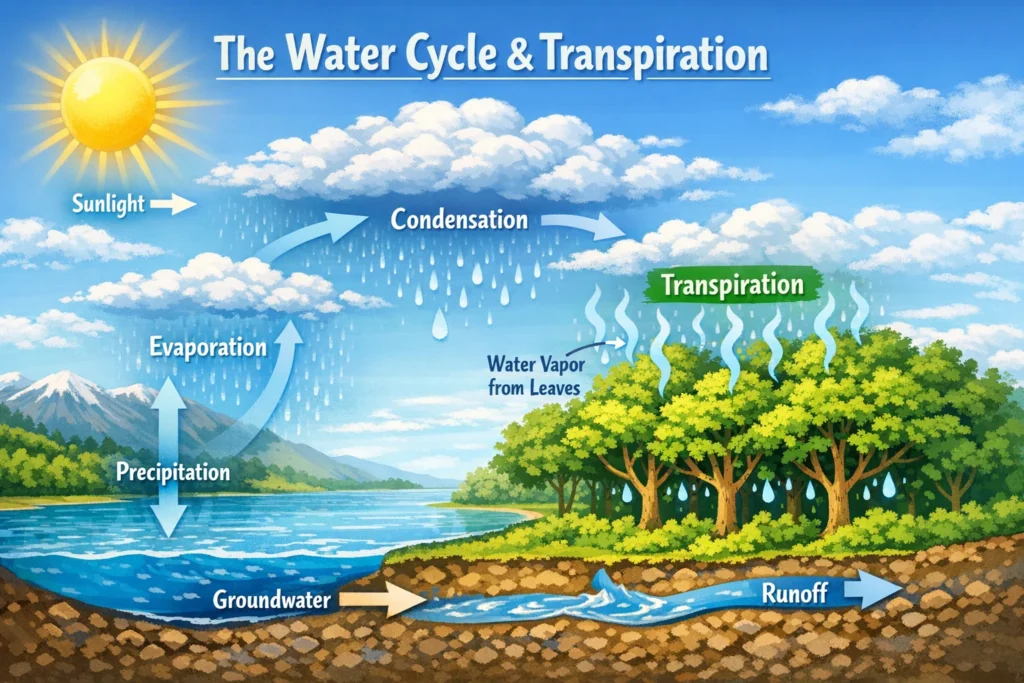
Transpiration in the water cycle is the process by which plants release water vapor into the atmosphere through tiny pores in their leaves, known as stomata.
When people think about the water cycle, they usually picture rain, rivers, or evaporation from oceans. But there’s a quiet, powerful process happening all around us right in the leaves of plants. This process is called transpiration, and it plays a crucial role in keeping Earth’s water cycle balanced.
Imagine trees “breathing out” water vapor into the air. That invisible release helps form clouds, regulate temperature, and even influence weather patterns. Without transpiration, the water cycle wouldn’t function the way it does today.
In this guide, you’ll learn exactly what transpiration means in the water cycle, how it works, why it matters, and how it compares to other processes like evaporation.
What Does Transpiration Mean in the Water Cycle?
Transpiration is a biological process where water absorbed by plant roots travels up through the plant and evaporates from the leaves into the atmosphere.
Simple Breakdown:
- Plants absorb water from the soil 🌱
- Water travels through stems to leaves
- Tiny pores (stomata) release water vapor into the air
- That vapor joins the atmosphere and contributes to clouds ☁️
Why It Matters:
- Maintains moisture in the atmosphere
- Helps regulate plant temperature
- Supports cloud formation and rainfall
How Transpiration Fits into the Water Cycle
The water cycle includes several key stages:
- Evaporation – Water turns into vapor from oceans, lakes, and rivers
- Transpiration – Plants release water vapor
- Condensation – Water vapor forms clouds
- Precipitation – Rain, snow, or hail falls
- Collection – Water gathers in bodies of water
Transpiration’s Role:
Transpiration is often grouped with evaporation as “evapotranspiration”, because both involve water turning into vapor.
The Science Behind Transpiration 🔬
Key Components:
- Stomata: Tiny openings on leaves that release water vapor
- Xylem: Tubes that transport water from roots to leaves
- Sunlight: Provides energy for evaporation
- Water Pressure: Drives water upward through the plant
How It Works Step-by-Step:
- Roots absorb water from the soil
- Water travels upward through xylem
- Sunlight heats the leaves
- Water evaporates through stomata
- Vapor enters the atmosphere
Origin and Scientific Background
The concept of transpiration has been studied for centuries in plant physiology and environmental science. Early botanists observed that plants lose water even when not visibly wet.
Key Historical Insights:
- Scientists discovered stomata in the 17th century
- Research in the 19th century confirmed water movement in plants
- Modern studies show transpiration affects climate patterns
Why It Became Important:
- Helps explain how forests influence rainfall
- Crucial for agriculture and irrigation planning
- Supports climate and weather research
Real-World Usage of Transpiration
Transpiration isn’t just a textbook concept it has real-life applications in multiple fields:
🌍 Environmental Science
- Forests release massive amounts of water vapor
- Influences regional rainfall patterns
🌾 Agriculture
- Helps farmers understand plant water needs
- Guides irrigation systems
🌡️ Climate Regulation
- Plants cool the environment through water release
- Reduces heat in urban areas
Examples of Transpiration in Daily Life
Example 1: Friendly Explanation 😊
“Plants release water vapor through their leaves it’s called transpiration, and it helps keep the air moist.”
Example 2: Neutral/Scientific Tone
“Transpiration contributes significantly to atmospheric moisture and plays a key role in the hydrological cycle.”
Example 3: Simplified Classroom Tone
“Plants sweat water into the air, just like humans sweat to cool down!”
Example Table: Transpiration Process Explained
| Stage | What Happens | Example |
|---|---|---|
| Water Absorption | Roots take in water from soil | Tree roots absorbing rainwater |
| Water Transport | Water moves through xylem | Water traveling up a stem |
| Evaporation | Water turns into vapor in leaves | Sun heating leaf surfaces |
| Release | Vapor exits through stomata | Invisible moisture entering air |
Comparison: Transpiration vs Other Water Cycle Processes
Understanding transpiration becomes easier when compared with similar processes:
| Process | Source | Description | Key Difference |
|---|---|---|---|
| Transpiration | Plants | Water released from leaves | Biological process |
| Evaporation | Water bodies | Water turns into vapor | Non-biological |
| Condensation | Atmosphere | Vapor turns into liquid | Forms clouds |
| Precipitation | Clouds | Water falls as rain/snow | Returns water to Earth |
Key Insight:
- Transpiration = Plants
- Evaporation = Water surfaces
Evapotranspiration: The Combined Effect
Scientists often use the term evapotranspiration to describe:
- Evaporation from soil and water
- Transpiration from plants
Why This Matters:
- Provides a complete picture of water loss to the atmosphere
- Essential for climate models and weather predictions
Alternate Meanings of “Transpiration”
While transpiration is mainly used in environmental science, it can have slight variations in meaning depending on context:
In Biology:
- Water loss from plants (primary meaning)
In General Language:
- Rarely used outside science
- Sometimes confused with “perspiration” (human sweating)
Common Misconceptions About Transpiration
Let’s clear up a few misunderstandings:
❌ “Plants don’t release water.”
✔️ They release large amounts of water vapor daily.
❌ “Transpiration is the same as evaporation.”
✔️ They are similar but not identical transpiration is plant-based.
❌ “It doesn’t affect weather.”
✔️ It plays a significant role in cloud formation and rainfall.
Polite and Professional Alternatives
If you’re explaining transpiration in different contexts, here are alternative ways to phrase it:
- “Plant water release process”
- “Leaf-based evaporation”
- “Biological water vapor release”
- “Moisture transfer from plants to air”
These alternatives can help simplify explanations for beginners.
Why Transpiration Is Important 🌱
1. Supports the Water Cycle
Without transpiration, less water would return to the atmosphere.
2. Helps Plants Survive
- Regulates temperature
- Maintains nutrient flow
3. Influences Climate
- Forests create humidity
- Affects rainfall patterns
4. Improves Air Quality
- Adds moisture to dry environments
Factors That Affect Transpiration
Several environmental factors control how much transpiration occurs:
🌞 Sunlight
- More sunlight = more transpiration
🌡️ Temperature
- Higher temperatures increase water loss
💨 Wind
- Wind removes moisture, increasing transpiration
💧 Soil Moisture
- Less water = reduced transpiration
🌿 Plant Type
- Different plants transpire at different rates
FAQs:
1. What is transpiration in simple words?
Transpiration is when plants release water vapor from their leaves into the air.
2. Why is transpiration important in the water cycle?
It helps return water to the atmosphere, contributing to cloud formation and rainfall.
3. Is transpiration the same as evaporation?
No. Transpiration happens in plants, while evaporation occurs from water surfaces.
4. What part of the plant is responsible for transpiration?
The stomata (tiny pores) on leaves control the release of water vapor.
5. What is evapotranspiration?
It is the combined process of evaporation and transpiration.
6. Does transpiration affect weather?
Yes. It influences humidity, cloud formation, and rainfall patterns.
7. Do all plants transpire?
Yes, but at different rates depending on species and environment.
8. What happens if transpiration stops?
Plants could overheat, and the water cycle would be disrupted.
Conclusion:
Transpiration may seem like a small, invisible process, but it has a massive impact on life on Earth. From helping plants stay healthy to influencing global weather patterns, it’s a vital part of the water cycle.
In simple terms, transpiration connects plants to the sky, acting as a natural bridge between the land and the atmosphere. It also plays a key role in keeping plants healthy, regulating temperature, and supporting ecosystems.
Discover More Related Articles:

Amanda Lewis is a professional content writer and word-meaning researcher who specializes in explaining definitions, slang, abbreviations, and modern language terms. She writes for WordNexy.com, where she creates clear, accurate, and reader-friendly articles to help users understand word meanings and proper usage. Her work is especially useful for students, writers, and online readers seeking quick and reliable explanations.