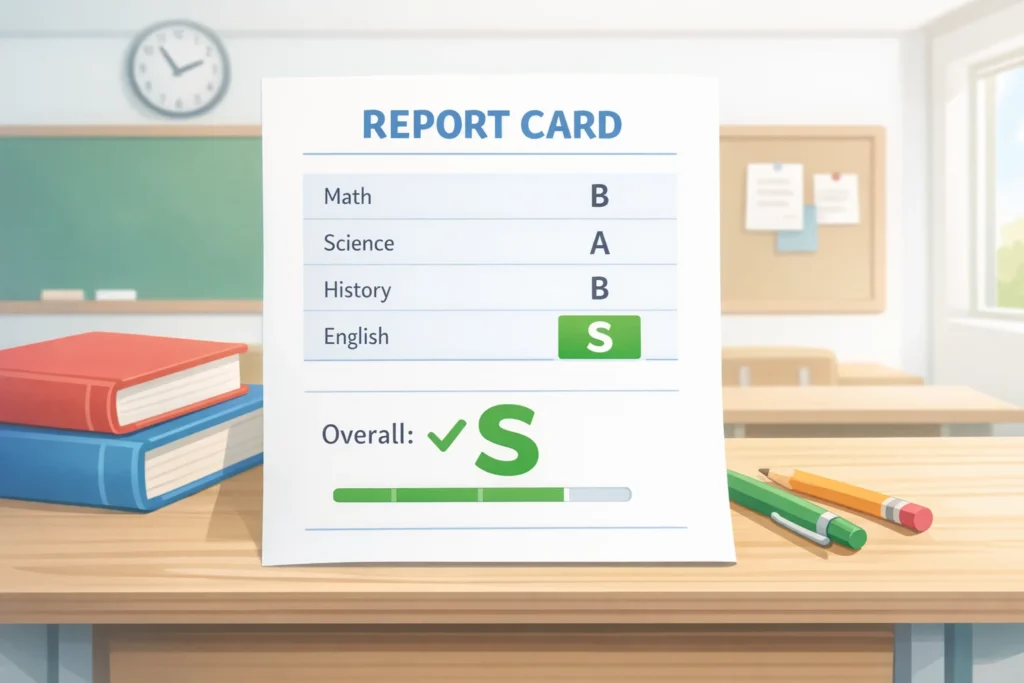
Definition:
In grading systems, an “S” typically stands for “Satisfactory.” It indicates that a student has met the expected standards or requirements for a course, assignment, or activity, but it usually does not provide a detailed measure of performance like letter grades (A–F).
If you’ve ever looked at a report card or transcript and spotted an “S” instead of an A, B, or C, you’re not alone in wondering what it means. Is it good? Is it average? Does it affect GPA?
The truth is, the meaning of “S” in grades depends on the grading system, but in most cases, it’s a positive sign that a student is performing at an acceptable level.
In this guide, you’ll learn exactly what an “S” grade means, how it’s used in schools, how it compares to traditional grading systems, and what it means for academic progress.
What Does an S Mean in Grades?
At its core, the “S” grade is simple:
- S = Satisfactory
- Indicates the student has met expectations
- Often used in non-traditional grading systems
- Typically does not impact GPA
Where Is the “S” Grade Commonly Used?
The “S” grade appears in a variety of educational settings:
1. Elementary and Middle Schools
Younger students often receive S/U grading instead of letter grades.
Example:
- Reading: S
- Behavior: S
- Homework: U
👉 Focus is on skill development, not academic ranking.
2. Pass/Fail Courses
In high schools and universities, some courses use:
- S = Pass (Satisfactory)
- U = Fail (Unsatisfactory)
These are often used for:
- Internships
- Labs
- Physical education
- Electives
3. Special Education Programs
Students may receive S grades based on:
- Individual progress
- Personalized learning goals
4. College Courses (Selective Cases)
Some universities allow students to opt for S/U grading instead of letter grades.
Why students choose this:
- Reduce GPA pressure
- Explore difficult subjects
- Maintain academic balance
Origin and Purpose of the “S” Grading System
The “Satisfactory” grading system was introduced as an alternative to traditional grading to:
- Reduce academic stress
- Encourage learning over competition
- Provide fair evaluation for skill-based subjects
Why It Became Popular
- Schools wanted to move beyond rigid grading
- Teachers needed a way to assess progress, not just scores
- It supports holistic education
Today, the system is widely used across:
- North America
- UK schools (in early years)
- International education systems
How Is “S” Different from Letter Grades?
Here’s a clear comparison:
| Grade Type | Meaning | Detail Level | GPA Impact | Common Use |
|---|---|---|---|---|
| A–F | Performance ranking | High | Yes | Most academic subjects |
| S | Satisfactory | Moderate | Usually No | Skills, behavior, pass/fail |
| P (Pass) | Passing grade | Low | Sometimes No | College electives |
| U | Unsatisfactory | Low | No | Indicates failure |
What Does “S” Actually Tell You?
An “S” grade answers one main question:
👉 Did the student meet expectations?
✔ Yes → S
❌ No → U
But it does NOT tell you:
- How well the student performed compared to others
- Whether the work was excellent or just acceptable
Real-Life Examples of “S” in Grades
Example Table: “S” Grade in Context
| Subject/Area | Grade | Meaning | Tone |
|---|---|---|---|
| Math Homework | S | Completed correctly and on time | 👍 Positive |
| Class Participation | S | Engaged and attentive | 🙂 Neutral-positive |
| Science Project | S | Met requirements but not exceptional | 😐 Neutral |
| Behavior | U | Needs improvement | ⚠️ Negative |
| Physical Education | S | Active and participating | 👍 Positive |
Tone and Interpretation of “S”
While “S” is generally positive, its tone can vary slightly depending on context:
👍 Positive Tone
- “You’re doing what’s expected—keep it up!”
- Indicates steady and reliable performance
😐 Neutral Tone
- “You met the basic requirements.”
- No strong praise or criticism
⚠️ Slightly Underwhelming Tone
- In high-achieving environments, “S” might feel average
- Especially if other systems include “E” (Excellent)
Comparison with Related Terms
Let’s compare “S” with similar grading terms:
Difference S vs P (Pass)
| Feature | S (Satisfactory) | P (Pass) |
|---|---|---|
| Meaning | Meets expectations | Simply passed |
| Detail | Slightly more descriptive | Basic |
| Usage | Schools & skill-based grading | Colleges |
S vs E (Excellent)
| Feature | S | E |
|---|---|---|
| Performance Level | Acceptable | Outstanding |
| Feedback Level | Basic | High praise |
| Motivation Impact | Moderate | Strong |
S vs C (Letter Grade)
| Feature | S | C |
|---|---|---|
| System | Alternative grading | Traditional grading |
| Meaning | Meets expectations | Average performance |
| GPA | Usually excluded | Included |
Alternate Meanings of “S” in Grades
While “S” usually means Satisfactory, it can have other meanings depending on context:
- Superior (rare, more positive than Satisfactory)
- Sufficient (used in some European systems)
- Satisfactory Progress (in progress reports)
👉 Always check your school’s grading guide to be sure.
When Is “S” a Good Grade?
In most cases, “S” is a good grade because:
- It means the student is meeting expectations
- It shows consistent effort
- It indicates successful completion
However, it may not be ideal if:
- You’re aiming for top academic honors
- You need GPA-based evaluation
- You want detailed performance feedback
Does an “S” Affect GPA?
Usually, no.
Most schools treat “S” grades as:
- Non-GPA impacting
- Equivalent to pass/fail
But exceptions exist:
- Some institutions may convert:
- S → Pass → equivalent to a C or higher
👉 Always check your institution’s policy.
Tips for Students and Parents
If You Receive an “S”:
- ✔ You’re on the right track
- ✔ You’re meeting expectations
- ✔ You should continue consistent effort
If You Want to Improve:
- Ask for detailed feedback
- Request rubrics or grading criteria
- Aim beyond “just meeting” expectations
Polite or Professional Alternatives to “S” in Reporting
In formal reports or communication, instead of just “S,” schools may use:
- “Meets Expectations”
- “Competent Performance”
- “Achieved Learning Objectives”
- “Satisfactory Progress”
These provide more clarity and sound more professional.
FAQs:
1. Is an “S” grade good or bad?
An “S” is generally considered a good grade, as it means the student has met the expected standards.
2. Does “S” mean average?
Not exactly. It represents acceptable or satisfactory performance, but it doesn’t rank students like traditional grades.
3. What is better: S or U?
S is better, since it means satisfactory performance, while U (Unsatisfactory) indicates the student did not meet expectations.
4. Does an “S” affect GPA?
In most cases, no, but it depends on the school or institution’s grading policy.
5. Is “S” the same as passing?
Yes, in most grading systems, “S” is equivalent to a passing grade.
6. Why do schools use “S” instead of letter grades?
Schools use it to emphasize learning, progress, and skill development rather than competition.
7. Can you fail with an “S”?
No. An “S” means you passed. Failing is typically marked as a “U.”
8. What comes after “S” in grading systems?
Some systems include additional levels such as:
- E (Excellent)
- N (Needs Improvement)
- U (Unsatisfactory)
Conclusion:
An “S” grade, meaning Satisfactory, is a clear sign that a student is meeting the required expectations. While it may not show detailed performance like traditional letter grades, it still represents a positive and passing outcome in most grading systems.
The key thing to remember is that “S” focuses on progress, effort, and completion rather than competition or ranking. It’s commonly used in schools to encourage learning without pressure and is usually GPA-neutral.
If you receive an “S,” you’re on the right track. And if you want to go beyond satisfactory, the next step is simple: aim for deeper understanding, stronger performance, and consistent improvement.
If you see an “S” on a report card, it’s a sign you’re doing what’s required. If you want to go further, aim beyond “satisfactory” by seeking feedback and pushing for excellence.
Discover More Related Articles:

James Anderson is an experienced content writer and language researcher who focuses on explaining word meanings, definitions, slang terms, and modern expressions. He writes for WordNexy.com, where his articles are designed to provide accurate meanings, practical usage examples, and easy-to-understand explanations for readers worldwide.